


Early weed control is paramount for maintaining high-profile, quality lawns, as young weeds are more manageable and controllable. Having a plan to address the weeds before their growth will save time and money and improve the health of the lawn.
Stop Weeds Before They Start
The best way to control weed invasion is to prevent weeds from germinating and rooting. This is accomplished by performing a pre-emergent weed control application in the spring before soil temperatures reach 55 degrees consecutively. Pre-emergent herbicides offer different control lengths based on the type of active ingredient within the pre-emergent. Pre-emergent weed control can be applied via granular particles or liquid form each spring and summer to control the weed population.
5 Reasons You Might be Dealing with Weeds After Applying Pre-emergent
Regardless of any pre-emergent weed control applications made, there is always the possibility of weed growth due to many factors.
-
Improper timing: Pre-emergent herbicides must be applied before weed seeds germinate. If used too late, weeds may have already sprouted.
-
Incomplete or Uneven Application: If coverage is not uniform, there will be gaps where pre-emergent herbicides do not exist within the soil to stop the weed seed from germinating.
-
Herbicide Breakdown (Short Residual or Heavy Rainfall): Weather conditions, such as heavy rainfall, may cause surface runoff and translocate or move pre-emergent herbicide from its intended target area, reducing its effectiveness.
-
Herbicide Resistance: Some weeds develop resistance to herbicides and don’t respond as well as they once did in controlling them.
-
Weeds Germinating from Deep in the Soil: Pre-emergent weed control occurs within the top ½” - 1”. However, certain weed seeds can germinate at greater depths below the protected area.

What are Post-Emergent Herbicides?
Post-emergent herbicides target weeds in the growing phase after germination. These herbicides are absorbed by the weed plant's leaf and root tissues and yield the best result when applied at an early growing stage.
The 4 Types of Post-Emergent Herbicides
1. Selective vs. Non-Selective
-
Selective herbicides target weeds without harming turfgrass lawns.
-
Non-selective herbicides kill all vegetation, including the lawn.
2. Contact vs. Systemic
-
Contact Herbicides kill only the part of the plant they touch (fast-acting).
-
Systemic Herbicides are absorbed into the plant and kill it from the inside out (slower but effective on deep-rooted weeds).

Post-emergent Herbicides for Lawn Weeds
Several post-emergent herbicides work on home lawns when used responsibly and according to the manufacturer's label. However, it should be predetermined whether weeds that have grown after pre-emergent applications need to be sprayed, as pulling weeds is always safer for the environment when the population is low. The following types will assist in early weed control if post-emergent herbicides are needed.
Applying post-emergent herbicides in the early stages of weed growth is best, as the weed will absorb the herbicides more effectively. Proper application standards should be practiced for environmental and personal safety when applying pre- and post-emergent herbicides.
Safety Guidelines For Herbicide Applications
Always wear Personal Protection Equipment (PPE) when applying chemical compounds to your lawn, and follow the label instructions. When mixing chemicals, measure accurately and use a calibrated sprayer. Mix in a dry area and always fill with water before adding herbicides or other chemicals. Never mix different chemicals before confirming that the mixture is compatible.
Avoid spraying herbicides when wind speeds exceed 10 mph, within 24 hours of rain to prevent runoff and environmental pollution, and when temperatures exceed 85 degrees Fahrenheit.
Protect water sources and the environment by keeping applications 10-20 feet away from water and not overwatering after application. Pre-emergent herbicides require watering to move consistently on the surface, creating a chemical barrier for weed control.
Storing herbicides is equally essential. When disposing of empty containers, follow the label. Triple rinse the container and create holes in the bottom so it is not reusable. Keep materials that aid in the absorption of herbicides close in the event an accidental spill occurs.
Build a Lawn That Weeds Can't Win: Simple Lawn Solutions Products for a Thick Lawn

Herbicides address the weeds that are already there. But the most effective long-term weed management strategy is building a lawn so thick and dense that weed seeds simply have no bare soil to establish in. A properly nourished, deeply rooted lawn physically out-competes weed seeds — sunlight doesn't reach bare ground, and emerging weed seedlings can't establish against healthy, dense turfgrass.
Simple Lawn Solutions doesn't sell herbicides, but we make the products that help you build the thick, healthy turf that makes weed control easier — and less necessary over time.
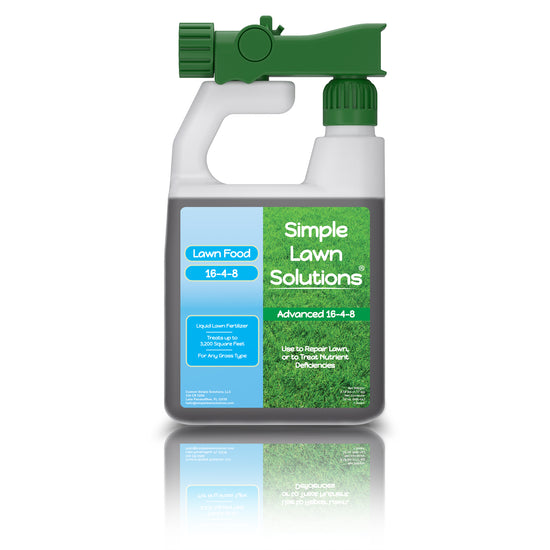
1. 16-4-8 Complete Balanced NPK Lawn Food (1 Gallon) Thicken Your Lawn to Crowd Out Weeds
NPK: 16-4-8 | $59.99 | Covers 12,800 sq ft
A thick, dense lawn is the most powerful weed prevention tool available. Dense turfgrass shades the soil surface, preventing weed seeds from receiving the light they need to germinate. It also physically occupies the rooting space that would otherwise be available to establishing weeds.
16-4-8 Lawn Food provides all three essential macronutrients in a single liquid application:
-
Nitrogen (16%) drives thick lateral growth, turf density, and deep green color. Dense, actively growing turf fills in bare spots where weeds establish.
-
Phosphorus (4%) supports strong, deep root development. Deep-rooted grass maintains density under stress and recovers faster from damage, leaving fewer gaps for weeds.
-
Potassium (8%) improves turf hardiness under heat, drought, and stress. Stressed, thinning grass is where weeds gain their footholds.
Infused with seaweed (kelp) and fish emulsion for improved nutrient uptake. One gallon covers 12,800 square feet.
Best for: Spring and fall on cool-season grasses (Fescue, Kentucky Bluegrass, Ryegrass); spring and summer on warm-season grasses (Bermuda, Zoysia, St. Augustine).
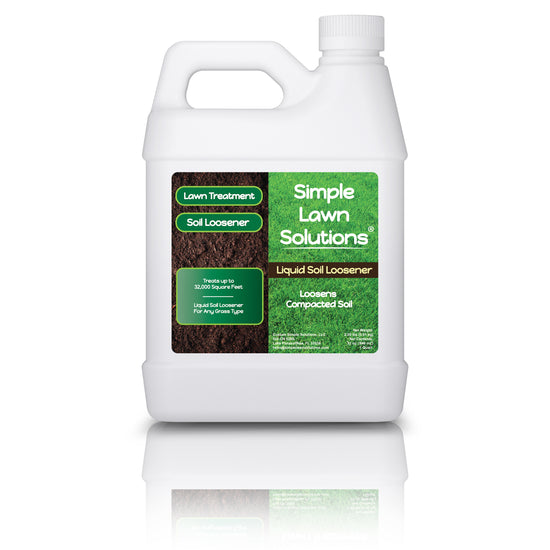
2. Liquid Soil Loosener (32 oz) Alleviate Standing Water Caused by Compacted Soil
$34.99 | Covers 32,000 sq ft
Compacted soil is one of the primary causes of thin, patchy turfgrass — and thin turfgrass is where weeds establish most easily. When soil becomes compacted, grass roots cannot penetrate deeply, nutrient and water uptake is restricted, and turf density declines. The resulting bare and thin areas are prime real estate for weed invasion.
Liquid Soil Loosener is a concentrated soil conditioning treatment that promotes the vertical movement of water and nutrients into the root zone.
Apply Liquid Soil Loosener before your spring fertilizer program as part of your weed prevention strategy: healthy soil → deep roots → dense turf → fewer weeds establishing.
Important: Apply at least 2 weeks before lawn food or boosters. Do not apply within 4 weeks of seeding.
3. Root Hume: Organic Humic Acid (32 oz) Build the Healthy Soil Beneath a Weed-Resistant Lawn
OMRI Certified | $24.99 | Covers 3,200 sq ft
Healthy soil grows healthy turf. Poor soil, low organic matter, poor structure, limited nutrient availability — grows weak, sparse grass that weeds invade opportunistically. Root Hume is a liquid humic acid soil conditioner derived from leonardite, the highest quality humate source, that supports nutrient availability, and roots over time.
Applied alongside your regular fertilizer program, Root Hume:
-
Increases the soil's cation exchange capacity, helping it hold fertilizer nutrients longer and release them to roots more efficiently
-
Improves soil water retention, reducing the stress cycles that thin and weaken turf
-
Chelates trace minerals and makes them available to grass roots
-
OMRI certified for organic use. Safe for all grass types.
The Weed Prevention Sequence: How to Use These Together
For a comprehensive weed prevention and lawn-thickening program, use these products in this order:
3–4 weeks before your pre-emergent application: Apply Liquid Soil Loosener and water in thoroughly in combination with core aeration. De-compacting the soil first ensures subsequent products can penetrate and perform optimally.
2 weeks before your pre-emergent: Apply Root Hume to begin improving soil health and encouraging deeper rooting.
Pre-emergent application: Apply your chosen pre-emergent herbicide per label directions before soil temperatures reach 55°F.
2 weeks after pre-emergent: Apply 16-4-8 Lawn Food to fuel spring growth. A dense, actively growing lawn in spring fills in bare spots before summer weed pressure begins.
FAQ Section
When should I apply pre-emergent weed control? Apply pre-emergent herbicide before soil temperatures reach 55°F for 3–5 consecutive days. In the Southeast and Gulf Coast, this is typically late February to mid-March. In the Midwest and Northeast, it's late March to mid-April. A soil thermometer is the most reliable tool — a calendar date alone is not sufficient since soil temperature varies year to year.
What temperature kills weed seeds before they germinate? Pre-emergent herbicides don't kill weed seeds — they prevent germination by disrupting cell division in the sprouting seed. The 55°F threshold is when most annual weeds (especially crabgrass) begin germinating. Applying before this threshold ensures the chemical barrier is in place before germination begins.
How long does pre-emergent last in the soil? Most residential pre-emergent products last 4–6 months from a single application. The exact duration depends on the active ingredient, soil temperature (heat breaks down some compounds faster), and rainfall. A spring application at the correct rate typically provides protection through the summer. A second application in late summer can extend control into fall.
Why do I still have weeds after applying pre-emergent? The five most common reasons are: applying too late (after soil temperatures already reached 55°F), incomplete coverage with gaps in the application, heavy rainfall that caused runoff before the product activated, herbicide resistance in the weed population, or weed seeds germinating from below the ½–1 inch protection zone. Identifying the cause helps you adjust for next season.
What is the difference between pre-emergent and post-emergent herbicide? Pre-emergent herbicides prevent weed seeds from germinating — they work in the soil before a weed is visible. Post-emergent herbicides kill weeds that have already germinated and are actively growing. Pre-emergents are used preventively before weed season; post-emergents are used reactively on established weeds.
When is the best time to apply post-emergent weed killer? Post-emergent herbicides work best when applied to weeds at the 2- to 4-leaf stage of growth (typically ½ to 2 inches tall). Young weeds absorb herbicides more effectively and have not yet developed protective wax coatings or deep root systems. Apply when temperatures are between 60–85°F for optimal herbicide activity. Avoid application in extreme heat, wind, or rain.
Is it safe to apply weed killer and fertilizer at the same time? Generally, it is best to separate herbicide and fertilizer applications by at least 2 weeks. Applying a herbicide and fertilizer simultaneously can stress the lawn and may reduce the effectiveness of both products. Apply your pre-emergent first, allow 2 weeks, then begin your spring fertilizer program. For post-emergents, allow the lawn to recover for 2–3 weeks after treatment before fertilizing.
What is the best way to prevent weeds without chemicals? The most effective non-chemical weed prevention strategy is maintaining a thick, dense turfgrass that shades the soil surface and fills available growing space before weeds can establish. This requires proper fertilization (nitrogen for density, phosphorus for root strength), soil health (decompaction and organic matter), appropriate mowing height (taller grass shades the soil better), and consistent irrigation. A well-maintained lawn naturally outcompetes most annual weed pressure.
Can I apply pre-emergent after it rains? Yes — in fact, light rain after a granular pre-emergent application helps water the product into the soil, which is necessary for activation. However, do not apply before heavy rain is forecast, as significant runoff can wash the product out of the target area before it has time to move into the soil. Liquid pre-emergents activate more quickly and are less susceptible to runoff once watered in.
The Importance of Proper Use of Pre and Post-Emergent Herbicides
Pre-emergent herbicides should be applied before weed seed germination in the spring. Once weeds germinate and begin to grow, a post-emergent herbicide can be used if applied in the early stages of growth. Pre-emergent herbicides are not guaranteed to control every weed seed germination, so some select areas will require mechanical removal or post-emergent herbicides for total control. Caution should be used when working with pre and post-emergent herbicides and applied per the manufacturer’s label. Use personal protection equipment (PPE) and monitor the weather before making applications to protect yourself and the environment. When appropriately used, pre and post-emergent herbicides can be an integral part of your lawn maintenance program for seasonal success.


1 comment
Thank you for the information….for the last few years I been doing what you suggested on keeping. My lawn weed free. I must say it works!