
Hot, dry weather can quickly change a green lawn into one that looks thin, brown, or dormant. But brown grass during drought is not always dead grass.
Many turfgrasses can survive periods of drought by slowing growth and entering dormancy. The goal of drought lawn care is not necessarily to keep your lawn perfectly green at all costs. Instead, it is to reduce stress, protect the crown and roots of the grass plant, conserve available moisture, and help the lawn recover once growing conditions improve.
A good drought lawn-care plan has three stages:
-
Prepare the lawn before drought develops
-
Reduce stress during drought
-
Support recovery after the drought ends
Fertilizer can play a role in that process, but timing matters. Applying the wrong fertilizer at the wrong time can encourage growth when the grass does not have enough water to support it.
What Happens to Grass During Drought?
Grass needs water for photosynthesis, nutrient movement, cell growth, and temperature regulation. When soil moisture becomes limited, turfgrass begins conserving resources. Growth slows, leaves may wilt or roll, and the grass can lose its green color.
As drought progresses, many grasses enter dormancy. Dormancy is a survival response in which above-ground growth slows dramatically while important plant tissues remain alive. This is why a lawn can look brown during a drought and still recover after rainfall or irrigation returns.
Signs of Drought Stress in Grass
Common signs can include:
-
Grass blades folding, curling, or wilting
-
A blue-gray or dull green appearance
-
Footprints remaining visible after walking across the lawn
-
Slower growth
-
Reduced mowing frequency
-
Brown or straw-colored turf
-
Dry, hard soil
-
Thinning turf in especially stressed areas
If the grass does not recover after adequate moisture returns, there may be other issues going on.

Before the Drought: Build a Healthier, More Resilient Lawn
The best time to prepare your lawn for drought is before severe drought stress begins. A lawn with healthy roots, appropriate mowing practices, adequate nutrition, and properly managed soil moisture is generally better positioned to tolerate stressful summer weather.
1. Know Your Grass Type
Different grasses respond differently to heat and drought.
Cool-Season Grasses
Common cool-season grasses include:
-
Tall fescue
-
Kentucky bluegrass
-
Perennial ryegrass
-
Fine fescues
Cool-season grasses grow most actively during cooler weather and may experience significant stress during hot, dry summers. Some can enter summer dormancy when water becomes limited.
Warm-Season Grasses
Common warm-season grasses include:
-
Bermudagrass
-
Zoysiagrass
-
St. Augustinegrass
-
Centipedegrass
-
Bahiagrass
Warm-season turf generally performs best during hotter weather, but prolonged drought can still cause serious stress. Your grass species should influence your watering, mowing, and summer lawn fertilizer strategy.
2. Check Your Soil
A soil test is one of the most useful tools for building an effective lawn-care program.
Testing can help identify:
-
Soil pH
-
Phosphorus status
-
Potassium status
-
Other soil characteristics
-
Fertilizer or amendment recommendations
A soil test is especially helpful before applying phosphorus or potassium-containing fertilizer. Avoid assuming that drought means your lawn automatically needs more fertilizer. Sometimes the limiting factor is simply water.

3. Encourage Healthy Roots Before Stress Arrives
A healthy root system gives turf access to a larger volume of soil and available water. Appropriate practices before drought may include:
-
Proper mowing
-
Deep, appropriate irrigation
-
Correct fertilizer timing
-
Soil testing
-
Addressing compaction when the lawn is actively growing
-
Avoiding repeated scalping
-
Maintaining the appropriate mowing height for the species
Root health develops over time. It cannot be created with one emergency application once the lawn is already severely drought-stressed.
4. Aerate at the Right Time (Not During Severe Drought)
Core aeration can be useful where soil compaction limits root growth and water infiltration. However, severe drought is not the ideal time to aggressively aerate a stressed lawn. Aeration temporarily disrupts the turf and soil. Schedule it during an appropriate active-growth period when the lawn has enough moisture and growing conditions are favorable for recovery.
For cool-season turf, that commonly means fall or another suitable cool growing period. Warm-season turf is typically aerated while actively growing during warmer weather.

5. Water Deeply and Appropriately Before Severe Drought
When irrigation is available, the goal is to encourage moisture to reach the root zone instead of repeatedly wetting only the surface. How much water your lawn requires depends on:
-
Soil type
-
Turf species
-
Temperature
-
Wind
-
Humidity
-
Shade
-
Root depth
-
Rainfall
-
Local watering restrictions
Avoid creating a rigid watering schedule without considering actual conditions.
What Is the Best Time to Water Your Lawn?
Early morning is generally the preferred time to irrigate turfgrass. Morning watering helps reduce evaporation compared with hotter portions of the day and allows grass foliage to dry as the day progresses.
6. Sharpen Your Mower Blade
A dull mower blade tears grass instead of cutting it cleanly. Sharpen the blade as needed and maintain a clean cut throughout the growing season.

Should You Fertilize Before a Drought?
If the lawn is healthy, actively growing, adequately watered, and your fertilizer program calls for nutrients, a properly timed application before drought stress develops may support normal turf growth.
Excessive nitrogen can stimulate additional leaf growth, which may increase the plant's water demand. The objective is balanced nutrition before stress, not forcing maximum growth before drought.
During a Drought: Shift Into Lawn Survival Mode
Once drought becomes severe, your priorities should change. During an active drought, focus on:
-
Conserving moisture
-
Protecting living turf tissue
-
Limiting traffic
-
Reducing mowing stress
-
Following watering restrictions
-
Avoiding unnecessary fertilizer
-
Allowing dormancy when appropriate
1. Raise Your Mowing Height
Cutting grass too short during hot, dry weather can increase stress. A taller canopy can provide more leaf area for photosynthesis and may help shade the soil surface. The correct mowing height depends on your turf species, but during a drought, avoid drastic height reductions. Follow the one-third rule, and avoid removing more than roughly one-third of the leaf blade in a single mowing whenever practical.
2. Mow Less Often
Drought-stressed grass grows more slowly. That means your mowing schedule should slow down. If the lawn is barely growing, there is little reason to mow simply because Saturday is your normal mowing day. Let grass growth determine mowing frequency.
3. Stay Off Severely Drought-Stressed Grass
Foot traffic, pets, equipment, and repeated mowing can physically damage dry turf. Dormant grass has a limited ability to recover from wear until favorable growing conditions return. Reduce unnecessary traffic across severely stressed areas.
4. Water Responsibly
Local drought restrictions should always take precedence over a lawn-care schedule. When irrigation is permitted, prioritize meaningful watering, rather than frequent shallow applications.
5. Accept Lawn Dormancy
For many homeowners, one of the most effective drought strategies is simply accepting that the lawn will not stay emerald green throughout severe drought. Dormancy is often a natural survival mechanism. A dormant lawn may look brown, but may contain living crowns and roots.
The exact drought tolerance and dormancy behavior varies by grass species, soil conditions, temperature, and length of the drought. Dormant turf may still require occasional irrigation during an extended drought to keep crowns and other vital tissues alive, where watering is permitted. The amount and frequency required vary by grass species, soil, weather, and local conditions. Follow local Extension guidance and watering restrictions.
Should You Fertilize Your Lawn During a Drought?
In most cases, avoid heavy fertilizer applications to severely drought-stressed or dormant grass. This is especially important with high-nitrogen fertilizer. Nitrogen promotes shoot growth. If there is not enough water to support that growth, the application may do little to help the lawn and can add stress.
Fertilizer also needs water to move nutrients into the soil and root zone. A better approach is usually to wait until:
-
Adequate moisture returns
-
Grass begins actively growing again
-
The lawn is capable of using the nutrients
-
Your fertilizer program indicates an application is appropriate

Can Liquid Fertilizer Be Used During Drought?
Liquid fertilizer is not automatically safer for drought-stressed grass simply because it is liquid. Whether an application is appropriate depends on:
-
Turf condition
-
Soil moisture
-
Product analysis
-
Application rate
-
Temperature
-
Irrigation availability
-
Product label directions
What About Nitrogen Fertilizer During Drought?
Nitrogen is one of the most important nutrients for turfgrass because it supports green color and shoot growth. However, high nitrogen rates should be used carefully during drought.
If grass is dormant or severely water-stressed, trying to force green growth may work against the lawn's natural stress response. Once moisture returns and the grass resumes active growth, nitrogen may again become appropriate depending on the season, grass type, and your overall fertility program.
Product Highlight: 28-0-0 High Nitrogen Liquid Lawn Food
When actively growing turf needs supplemental nitrogen, Simple Lawn Solutions 28-0-0 provides nitrogen without added phosphate or potash.
Best fit: Actively growing turf where supplemental nitrogen is appropriate, not severely drought-stressed or dormant grass.
Shop 28-0-0 High Nitrogen Lawn Food →
Does Potassium Help Grass During Drought?
Potassium is involved in many important plant processes, including water regulation, enzyme activity, and plant stress responses. That has led to potassium sometimes being marketed as a "stress" or drought nutrient.
However, there is an important distinction: Potassium can support normal plant function when the soil is deficient, but applying extra potassium to soil that already contains sufficient potassium does not automatically make a lawn drought-proof. A soil test can help determine whether additional potassium is appropriate.
Product Highlight: 3-18-18 High Phosphorus & Potassium
If soil testing and your lawn-care program indicate that phosphorus and potassium are needed, Simple Lawn Solutions 3-18-18 supplies:
3% nitrogen – 18% available phosphate – 18% soluble potash
Because it contains relatively little nitrogen compared with its phosphorus and potassium analysis, it serves a different purpose than a high-nitrogen fertilizer.
Best fit: Lawns where soil testing or an established fertility program indicates phosphorus and potassium are appropriate.
Shop 3-18-18 High Phosphorus & Potassium →

Avoid These Lawn-Care Practices During Severe Drought
When your grass is already struggling, avoid adding unnecessary stress.
Heavy Nitrogen Fertilization: Don't force rapid top growth when soil moisture cannot support it.
Scalping the Lawn: Removing too much leaf tissue reduces the plant's photosynthetic area and increases stress.
Aggressive Dethatching: Dethatching can be disruptive. Severe drought is not the time for aggressive renovation.
Core Aeration in Severely Dry Turf: Aerate during the appropriate active-growth period when the turf can recover.
Heavy Traffic: Reduce recreational activity and repeated equipment use over dormant or severely stressed turf.
Applying Fertilizer Before Heavy Rain: Heavy rainfall can increase nutrient runoff. Allow soil moisture and turf growth to normalize, and choose fertilizer timing based on lawn conditions and label directions.
After the Drought: How to Help Your Lawn Recover
When rainfall returns or watering restrictions ease, don't immediately assume the lawn needs aggressive renovation. Give the grass time to respond.
1. Determine Whether the Grass Is Dormant or Dead
Once sufficient moisture returns, dormant grass should gradually begin producing new green growth if living crowns and roots survived. If areas remain completely brown while the surrounding turf recovers, investigate whether those areas died. Dead patches may eventually require reseeding, sod, plugs, or other repair, depending on the grass species.
2. Restore Consistent Moisture
A recovering lawn needs adequate moisture. Avoid alternating between severe dryness and excessive watering. Water according to soil conditions, weather, and your turf species.
3. Resume Mowing Carefully
Once growth resumes, begin mowing at the recommended height for your grass. Don't try to "clean up" the lawn by cutting off large amounts of tissue at once. Gradually return it to your normal mowing routine.
When Should You Fertilize After a Drought?
Wait until the lawn has adequate moisture and is actively growing again. The exact timing depends heavily on grass type and season.
For example:
-
A cool-season lawn recovering as fall approaches may be entering a favorable fertilization period.
-
A warm-season lawn recovering during its active summer growing period may also absorb nutrients.
-
A warm-season lawn recovering very late in the season may need a different strategy as dormancy approaches.
Don't fertilize simply because the drought ended. Fertilize because the grass is actively growing and the nutrients are appropriate for your lawn.
What Is the Best Fertilizer for Grass After a Drought?
There isn't one universal "best fertilizer for drought recovery." The right fertilizer depends on what nutrients the lawn needs.
If the Lawn Needs Nitrogen
Nitrogen supports turfgrass shoot growth and green color. A nitrogen-focused fertilizer such as 28-0-0 may be appropriate when grass is actively growing.
If the Lawn Needs General N-P-K Nutrition
A complete fertilizer supplies nitrogen, phosphate, and potash.
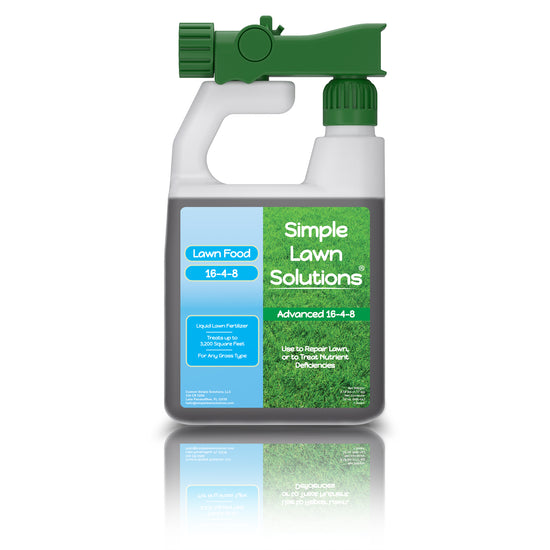
Simple Lawn Solutions 16-4-8 Liquid Lawn Food provides:
16% nitrogen – 4% available phosphate – 8% soluble potash
This can be an option where all three nutrients are appropriate.
Shop 16-4-8 Complete N-P-K Lawn Food →
If Soil Testing Indicates Phosphorus or Potassium Is Needed
A fertilizer such as 3-18-18 provides higher amounts of phosphate and potash relative to nitrogen. Select these products based on actual nutrient needs rather than the assumption that every stressed lawn needs phosphorus or potassium.
Should You Kill Weeds Immediately After a Drought?
Not necessarily. Weeds may become more noticeable where drought has thinned the turf, but timing herbicide applications while the lawn and weeds are severely stressed may reduce effectiveness or increase turf injury with some products.
Once conditions improve:
-
Identify the weeds
-
Confirm that the turf has resumed active growth
-
Choose an herbicide labeled for the weed and turfgrass
-
Follow all label temperature and application restrictions
A dense, properly maintained lawn is also one of the best long-term defenses against future weed invasion.
Drought Lawn Recovery Checklist
Once normal moisture returns:
-
Check whether dormant grass is greening up
-
Resume appropriate watering
-
Begin mowing as growth returns
-
Inspect for dead areas
-
Soil test if fertility is uncertain
-
Fertilize only when active growth resumes
-
Repair dead turf if needed
-
Address weeds at the appropriate time
-
Delay aggressive renovation until conditions favor recovery
Help Your Lawn Recover With the Right Nutrition
Once moisture has returned and your grass is actively growing again, Simple Lawn Solutions offers liquid lawn fertilizers for different nutrient needs.

Not sure what your lawn needs?
Contact Simple Lawn Solutions → for help choosing a lawn-care approach based on your grass, growing conditions, and goals.
FAQs
Should I water my lawn every day during a drought?
Usually, daily shallow watering is not the ideal goal for established turf. Watering recommendations depend on soil type, grass species, weather, rooting depth, irrigation restrictions, and whether your objective is maintaining active growth or simply keeping dormant grass alive. Follow local restrictions and regional extension guidance.
Should I fertilize my lawn during a drought?
Avoid heavy fertilizer applications to severely drought-stressed or dormant turf. Fertilizer is generally more useful once adequate moisture is available and grass is actively growing.
Can fertilizer burn grass during hot weather?
Fertilizer injury risk depends on product type, rate, temperature, soil moisture, application technique, and irrigation. Applying excessive fertilizer to dry, stressed turf can increase the chance of injury. Always follow label directions.
What fertilizer is best for drought-stressed grass?
There isn't a universal fertilizer for drought-stressed grass. If the lawn is severely stressed or dormant, fertilizer may not be appropriate at all. After active growth resumes, select fertilizer based on grass type, soil testing, season, and nutrient requirements.
Does nitrogen help grass recover from drought?
Nitrogen supports green color and shoot growth once turf is actively growing. Avoid using high nitrogen rates to force growth while the lawn remains severely drought-stressed.
Does potassium make grass more drought-tolerant?
Potassium supports important plant processes related to water regulation and stress response. However, applying additional potassium is most useful when the soil is potassium-deficient.
Will brown grass turn green again after a drought?
Often, yes. Brown grass may be dormant. If the crowns and roots remain alive, the lawn can begin greening after moisture and favorable growing conditions return.
How can I tell if drought-stressed grass is dead?
Give the lawn adequate moisture and time to respond. Areas that remain brown while the surrounding turf resumes active growth may be dead. Inspecting crowns, roots, and signs of new shoots can also help determine whether the turf survived.
Should I mow my lawn during a drought?
Mow only when the grass is actually growing. Raise the mowing height as appropriate for your species, use a sharp blade, and avoid removing excessive leaf tissue in a single mowing.
Should I aerate my lawn during drought?
Avoid aggressive core aeration while the lawn is severely drought-stressed. Aerate during a suitable active-growth period when moisture and growing conditions allow the turf to recover.
Should I dethatch after a drought?
Wait until the turf is actively growing and weather conditions favor recovery before performing disruptive practices such as dethatching.
Is liquid fertilizer better for drought-stressed grass?
Not automatically. Liquid fertilizer still supplies nutrients that the plant must be capable of using. Soil moisture, grass activity, fertilizer analysis, rate, and label instructions matter more than simply whether the fertilizer is liquid or granular.
How soon after rain should I fertilize after a drought?
Don't fertilize based solely on the first rainfall event. Allow soil moisture to improve and determine whether the grass has resumed active growth. Avoid applications immediately before heavy rainfall that may increase runoff.
References
-
University of Minnesota Extension — Lawn care during drought
https://extension.umn.edu/lawn-care -
Purdue University Extension — Turfgrass and lawn management resources
https://turf.purdue.edu/ -
Penn State Extension — Turfgrass and lawn care
https://extension.psu.edu/trees-lawns-and-landscaping/turfgrass-and-lawn-care -
University of Nebraska–Lincoln Extension — Turfgrass and drought management resources
https://turf.unl.edu/ -
Colorado State University Extension — Lawn and turfgrass resources
https://extension.colostate.edu/topic-areas/yard-garden/ -
Clemson Cooperative Extension — Lawn and turfgrass resources
https://hgic.clemson.edu/category/lawns/ -
University of Florida IFAS Extension — Lawn and turfgrass resources
https://gardeningsolutions.ifas.ufl.edu/lawns/ -
NC State Extension — Turfgrass management and maintenance resources
https://www.turffiles.ncsu.edu/ -
U.S. Environmental Protection Agency — Nutrient pollution
https://www.epa.gov/nutrientpollution