
If you’re wondering what months you should fertilize your lawn, the short answer is: Cool-season lawns are generally fertilized during spring and fall, while warm-season lawns are typically fertilized from late spring through summer.
But there is no single fertilizer calendar that works for every lawn in the United States. A tall fescue lawn in Columbus, Ohio, may need a different fertilizer schedule than tall fescue in Atlanta, Georgia. And a tall fescue lawn in Nashville, Tennessee, will grow differently from bermudagrass in the same city.
That’s why the best time to fertilize your lawn depends on:
-
Your grass type
-
Your location and climate
-
When your lawn is actively growing
-
Weather conditions
-
Soil fertility
-
Previous fertilizer applications
-
Whether the lawn is under heat, drought, or other environmental stress
Instead of fertilizing simply because the calendar says April, July, or September, the better approach is to fertilize when your grass is actively growing and can use the nutrients you apply.

What Is the Best Month to Fertilize Your Lawn?
There isn’t one universal “best month.” However, these general windows can serve as a useful starting point:
|
Grass Type |
Typical Fertilizer Window |
Common Months |
|
Cool-season grass |
Spring and fall |
April–May and August–October |
|
Warm-season grass |
Late spring through summer |
May–August or early September |
|
Transition-zone lawns |
Depends heavily on species |
Varies |
Temperature, active growth, rainfall, grass species, and regional recommendations can move the fertilizer window earlier or later.
Why Grass Type Matters More Than the Calendar
When it comes to building a lawn fertilizer schedule, knowing whether you have cool-season or warm-season grass is one of the most important first steps.
Common Cool-Season Grasses
Cool-season grasses include:
-
Tall fescue
-
Kentucky bluegrass
-
Perennial ryegrass
-
Fine fescues
These grasses generally grow most actively during cooler spring and fall weather.
Common Warm-Season Grasses
Warm-season grasses include:
-
Bermudagrass
-
Zoysiagrass
-
St. Augustinegrass
-
Centipedegrass
-
Bahiagrass
These grasses thrive as temperatures rise and generally grow most vigorously during late spring and summer. Not sure which type you have? Read our guides to identifying warm-season grasses and cool-season grasses.

When Should You Fertilize Cool-Season Grass?
For most cool-season lawns, the primary fertilizer periods are spring and fall, with fall being the strongest time to fertilize. These grasses perform best during cooler conditions and tend to slow down during periods of summer heat and drought.
Spring Fertilizer for Cool-Season Lawns
A spring fertilizer application may be appropriate once the lawn is actively growing.
For many cool-season lawns, this may fall somewhere around April or May, depending on climate and location. If you live farther north, active growth may begin later. If you grow cool-season turf farther south, spring growth may begin earlier. If your lawn is actively growing and you’re mowing regularly, that is a stronger indication that the turf is using nutrients.
Should You Fertilize Cool-Season Grass in Summer?
Use caution as cool-season turf can experience significant heat and drought stress during summer. Applying heavy nitrogen fertilizer during periods of severe stress can encourage growth that the lawn may not have enough moisture to support. If the lawn is dormant or severely drought-stressed, fertilization may be better delayed.
Instead, evaluate:
-
Soil moisture
-
Heat stress
-
Grass activity
-
Irrigation availability
-
Fertilizer formulation
Fall Fertilizer for Cool-Season Lawns
Fall is one of the most important fertilizer periods for many cool-season lawns. As temperatures cool after summer, these grasses often return to active growth.
A typical three-application schedule might look something like:
-
Late spring
-
Early fall
-
Later fall
For some homeowners, that may translate roughly to:
May → September → October
But your actual dates may shift earlier or later depending on location.
Example Cool-Season Fertilizer Schedule
A lawn in the northern United States may follow a schedule closer to:
Late May → Late August → Late September
A cool-season lawn farther south may be closer to:
Late April → Mid-September → Late October
What Fertilizer Should You Use on Cool-Season Grass?
The best fertilizer depends on what nutrients your lawn needs. For a lawn-care program that calls for nitrogen, phosphorus, and potassium, a complete fertilizer may be appropriate.
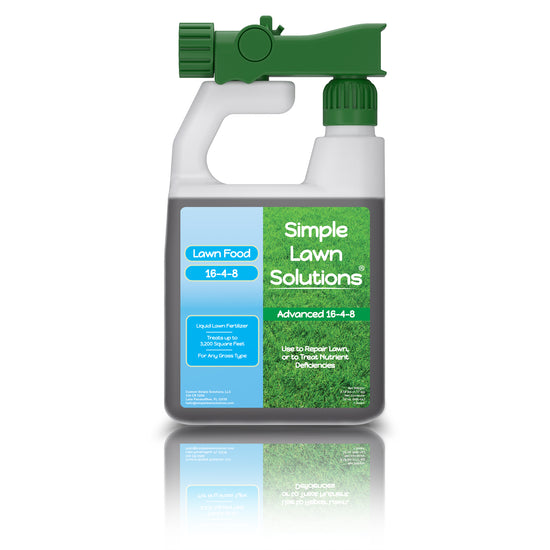
Product Highlight: 16-4-8 Complete N-P-K Lawn Food
Simple Lawn Solutions 16-4-8 provides all three primary fertilizer nutrients. This can be an option for actively growing turf where all three nutrients are appropriate.
Shop 16-4-8 Complete N-P-K Lawn Food →
When Should You Fertilize Warm-Season Grass?
Warm-season lawns have a very different fertilizer schedule. Their active-growth period usually occurs from late spring through summer. When temperatures rise and the grass is fully growing, nutrient demand also increases.
Spring Fertilizer for Warm-Season Lawns
Avoid fertilizing based solely on the first warm day of spring because warm-season grasses may still be transitioning out of dormancy. Wait until the turf has resumed active growth before beginning the main fertilizer program. Depending on your location, this might happen in late spring.
Summer Fertilizer for Warm-Season Grass
Summer is the primary growing season for many warm-season lawns, and is an important period for applying fertilizer when nutrients are needed. A simple three-application warm-season schedule might look like:
Spring green-up → active early-summer growth → active midsummer growth → taper fertility as dormancy approaches
Should You Fertilize Warm-Season Grass in Fall?
As warm-season turf approaches dormancy, its nutrient requirements begin to change. Avoid continuing a heavy summer fertilizer program simply because you’ve reached another month on the calendar.
Your late-season fertilizer strategy should consider:
-
Grass species
-
Climate
-
Whether the grass is still growing
-
Soil nutrient levels
-
Fertilizer analysis
-
Local Extension recommendations
What Fertilizer Should You Use on Warm-Season Grass?
Again, there is no single best fertilizer. If your lawn needs nitrogen during active growth, a nitrogen-focused product may be appropriate.
Product Highlight: 28-0-0 High Nitrogen Liquid Lawn Food
Simple Lawn Solutions 28-0-0 supplies nitrogen without added phosphate or potash. Nitrogen is closely associated with turfgrass color and shoot growth.
Best fit: Actively growing turf where nitrogen is the nutrient you specifically want to supply.
Shop 28-0-0 High Nitrogen Lawn Food →
How Often Should You Fertilize Your Lawn?
There is no universal number of fertilizer applications per year. Some lawns may perform well with a relatively simple schedule, while more intensively managed lawns may use smaller applications more frequently.
How often you fertilize should depend on:
-
Grass species
-
Growing season length
-
Fertilizer analysis
-
Application rate
-
Soil fertility
-
Previous applications
-
Lawn condition
-
Desired maintenance level
Instead of focusing only on the number of fertilizer applications, consider the total nutrients being supplied throughout the growing season. More applications do not automatically mean a healthier lawn.
Should You Soil Test Before Fertilizing?
A soil test is one of the best ways to reduce guesswork in lawn fertilization.
Testing may provide information about:
-
Soil pH
-
Phosphorus
-
Potassium
-
Other soil characteristics
-
Fertilizer or amendment recommendations
This is especially useful before applying phosphorus-containing fertilizer. Do not assume every lawn needs all three fertilizer nutrients every time you fertilize.
What Do the Numbers on Lawn Fertilizer Mean?
Most lawn fertilizers display three prominent numbers. These are commonly referred to as the N-P-K numbers. In conventional U.S. fertilizer labeling, they represent:
-
N — Nitrogen
-
P₂O₅ — Available phosphate
-
K₂O — Soluble potash
What Does Nitrogen Do for Grass?
Nitrogen is strongly associated with:
-
Green turf color
-
Leaf growth
-
Shoot growth
-
Turf density
That’s why nitrogen fertilizers are often used during periods of active growth.
What Does Phosphorus Do for Grass?
Phosphorus supports:
-
Root development
-
Energy transfer
-
Cell division
-
Seedling establishment
However, mature lawns may not need additional phosphorus when soil levels are already sufficient.
What Does Potassium Do for Grass?
Potassium plays roles in:
-
Water regulation
-
Enzyme activity
-
Plant stress responses
-
Overall plant function
Like phosphorus, potassium should be applied based on actual lawn needs rather than assuming more is always better.

Which Simple Lawn Solutions Fertilizer Should You Use?
The right product depends on what your grass needs at the time of application.
|
Lawn Goal |
Product to Consider |
|
General N-P-K nutrition |
|
|
Primarily nitrogen |
|
|
Phosphorus and potassium needs |
|
|
Nitrogen and phosphorus |
|
|
Seasonal fall nutrition |
16-4-8 Complete N-P-K
16-4-8 Liquid Lawn Food supplies nitrogen, phosphate, and potash for situations where all three nutrients are appropriate.
28-0-0 High Nitrogen
28-0-0 High Nitrogen Lawn Food provides nitrogen without added phosphorus or potassium.
3-18-18 High Phosphorus & Potassium
3-18-18 supplies high phosphate and potash with less nitrogen. This may be useful where soil testing or a fertility program indicates those nutrients are appropriate.
6-18-0 Growth Booster
6-18-0 Growth Booster supplies nitrogen and phosphate without potassium.
Shop Simple Lawn Solutions Lawn Fertilizers →
What Time of Year Is Best for Nitrogen Fertilizer?
The best time to apply nitrogen is generally during the active growing season for your particular grass. For cool-season grasses, that commonly means spring and fall. For warm-season grasses, it generally shifts to late spring and summer. Avoid assuming high-nitrogen fertilizer should be applied whenever the grass looks brown.
Brown turf may be:
-
Dormant
-
Drought-stressed
-
Heat-stressed
-
Diseased
-
Damaged
When Should You Avoid Fertilizing Your Lawn?
There are several situations where delaying fertilizer may be a better choice.
-
During Severe Drought: Severely drought-stressed or dormant turf may not be able to use fertilizer efficiently.
-
During Extreme Heat Stress: Heavy fertilization can encourage additional growth during conditions where the plant is already struggling.
-
Before Heavy Rain: Heavy rainfall can increase runoff and nutrient loss.
-
When the Grass Is Dormant: Fertilizer should generally be timed to active growth unless a specific regional recommendation or management objective says otherwise.
-
When You Don’t Know What the Lawn Needs: A soil test can help answer that question.
Common Lawn Fertilizing Mistakes
-
Fertilizing Every Lawn on the Same Dates: Different grasses and climates require different schedules.
-
Applying Too Much Nitrogen: More nitrogen does not automatically create a healthier lawn.
-
Assuming Every Fertilizer Should Contain Phosphorus: Many established lawns do not need routine phosphorus applications unless soil testing shows a need.
-
Ignoring Weather Conditions: Temperature, moisture, and drought stress matter just as much as the month.
-
Using the Same Fertilizer All Year: Lawn nutrient needs can change throughout the growing season.
-
Ignoring the Fertilizer Label: Always follow the product's application rate, coverage, watering, storage, and safety directions.
FAQs
What month should I fertilize my lawn?
There is no single best month. Cool-season lawns are generally fertilized during spring and fall, while warm-season lawns are commonly fertilized from late spring through summer.
Is April a good month to fertilize grass?
It can be for some actively growing cool-season lawns, particularly in milder climates. However, April may be too early in colder regions or too early for warm-season grass that has not fully resumed active growth.
Is May a good month to fertilize the lawn?
May can be a useful fertilizer period for both some cool-season and warm-season lawns, depending on location and growth stage. The lawn should be actively growing and free from severe environmental stress.
Should I fertilize my lawn in June?
June may be appropriate for actively growing warm-season turf. Cool-season grass may be entering summer stress depending on the climate.
Is July a good month to fertilize grass?
July can be an active fertilizer period for warm-season lawns. Use more caution with cool-season turf during high heat and drought.
Should I fertilize my lawn in August?
That depends on the grass type and location. Warm-season lawns may still be actively growing, while cool-season grasses in northern climates may begin transitioning toward their important fall growth period.
Is September a good month to fertilize a lawn?
September is often an important fertilizer month for cool-season grass because cooler temperatures can encourage renewed growth. Warm-season turf may still be active in some southern climates but approaching dormancy in others.
Should I fertilize in October?
October can be part of a cool-season fall fertilizer program in many regions, but timing varies with climate. Warm-season lawns may already be slowing considerably.
What is the best time of day to fertilize a lawn?
The fertilizer label should guide application conditions. Avoid extreme heat, excessive wind, and conditions where runoff is likely. Some liquid products may have specific recommendations for temperature, moisture, and watering.
Should I fertilize before or after mowing?
Either may be appropriate depending on the product. More important factors include proper application rate, grass activity, soil moisture, and label directions.
Should I water after applying fertilizer?
It depends on the fertilizer formulation. Some products should be watered into the root zone, while others have different instructions. Always follow the label.
Can I fertilize wet grass?
That depends on the product. Some fertilizers are designed for application to dry foliage, while others may be used under different conditions. Follow the specific label.
Can I fertilize during a drought?
Heavy fertilizer applications are generally not ideal for severely drought-stressed or dormant turf. Wait until adequate moisture returns and active growth resumes unless your specific turf-management program recommends otherwise.
How many times per year should grass be fertilized?
There is no universal number. Frequency depends on turf species, climate, soil fertility, fertilizer rate, and desired lawn-management intensity.
What fertilizer makes grass greener?
Nitrogen is the nutrient most strongly associated with turfgrass color and shoot growth. However, apply it according to lawn needs rather than simply increasing nitrogen whenever you want a darker color.
Is 28-0-0 fertilizer good for lawns?
28-0-0 supplies nitrogen without phosphate or potash. It can be useful when nitrogen is the specific nutrient your lawn needs during active growth.
Is 16-4-8 fertilizer good for grass?
16-4-8 supplies nitrogen, phosphate, and potash, and can be appropriate where all three nutrients are part of the lawn's fertility needs.
Is liquid lawn fertilizer better than granular fertilizer?
Neither is automatically better. Both can supply nutrients effectively when properly formulated and applied. The best choice depends on application preference, nutrient needs, fertilizer source, rate, and lawn-management goals.
Fertilize According to Growth, Not Just the Month
So, what months should you fertilize your lawn?
A useful starting point is:
Cool-season lawns: Spring and fall
Warm-season lawns: Late spring through summer
But the calendar should never be your only guide.
The best fertilizer timing depends on:
-
What grass type you have
-
Where you live
-
Whether the grass is actively growing
-
Current weather conditions
-
Soil fertility
-
Which nutrients your lawn needs
Your lawn doesn't know whether it's May 1 or September 15. It responds to temperature, moisture, sunlight, nutrients, and its natural growth cycle. The best fertilizer program uses the calendar as a planning tool, but lets the grass determine the final timing.
Take the Guesswork Out of Lawn Fertilization
Whether your lawn needs high-nitrogen fertilizer, complete N-P-K nutrition, phosphorus and potassium, or seasonal lawn food, Simple Lawn Solutions offers fertilizer options for different lawn-care goals.
Shop Simple Lawn Solutions Lawn Fertilizers →
Not sure where to begin?
Contact Simple Lawn Solutions → for help choosing a fertilizer program based on your grass, growing conditions, and lawn-care goals.
References
-
Purdue University Turfgrass Science — fertilizer timing and cool-season turf management
https://turf.purdue.edu/ -
Penn State Extension — Turfgrass & Lawn Care
https://extension.psu.edu/trees-lawns-and-landscaping/turfgrass-and-lawn-care -
University of Minnesota Extension — Lawn Care
https://extension.umn.edu/lawn-care -
University of Maryland Extension — Lawns
https://extension.umd.edu/resource/lawns/ -
NC State Extension — TurfFiles
https://www.turffiles.ncsu.edu/ -
Clemson Cooperative Extension — Lawns
https://hgic.clemson.edu/category/lawns/ -
University of Florida IFAS — Lawn Care
https://gardeningsolutions.ifas.ufl.edu/lawns/ -
University of Georgia Extension — Turfgrass
https://extension.uga.edu/