


If you live in the South, you know bermudagrass can either look incredible, or like a patchy, yellow mess. Bermuda is a fast-growing, aggressive grass that thrives in heat—but it also burns through nutrients quickly. If you’re not feeding it the right way (and at the right time), it simply won’t give you that thick, dark green lawn you’re after.
In this guide, you’ll learn the best fertilizer for bermudagrass, why liquid lawn fertilizer works so well, and exactly how to use it for a lush, healthy lawn this season.
What Is the Best Fertilizer for Bermudagrass?
The best fertilizer for bermudagrass is a high-nitrogen fertilizer, typically with an NPK ratio like 16-4-8 or similar, applied regularly during the growing season.
For the best results during spring and summer grass care, liquid lawn fertilizer is often the top choice because it:
-
Absorbs quickly
-
Provides even coverage
-
Produces faster green-up
If your goal is a thick, green Southern lawn, a consistent liquid fertilization program will outperform most granular options.

Why Bermudagrass Needs the Right Fertilizer
Bermudagrass isn’t a low-maintenance lawn. It grows fast, spreads aggressively, and thrives in hot climates. With the right fertilizer strategy, it becomes dense, dark, and resilient.
Here’s what makes bermudagrass different:
-
High nutrient demand – especially nitrogen
-
Rapid growth cycle – burns through fertilizer quickly
-
Southern soils – often sandy or low in organic matter
-
Heat stress – requires nutrients to stay green under pressure
Without proper fertilization, bermudagrass becomes:
-
Thin
-
Pale
-
Weak against weeds
Liquid Lawn Fertilizer vs Granular: What’s Better for Bermudagrass?
Both options can work, but liquid fertilizer has some clear advantages for bermudagrass. Plants need three basic nutrients for growth, root development, enhancing green, and strengthening. Those nutrients are nitrogen, phosphorus, and potassium. Both liquid lawn fertilizer and granular fertilizer contain these three main nutrients, and while a plant can’t tell the source of the nutrient, it could be sensitive to the rate and delivery method.
Most liquid lawn fertilizer delivers a quick release of nutrients, while granular fertilizer has a slow release for your plants. When comparing liquid lawn fertilizer to granular fertilizer, we can look at the difference in the distance from the fertilizer nutrients to the plant roots for absorption to take place. Phosphorus is not a very mobile nutrient, and it has a hard time moving from where the fertilizer was applied to the root of the plants. Applying liquids directly to the leaf blades will allow for a more rapid response.
Most granular fertilizers are meant to be slow-release fertilizers. Granular fertilizers usually contain higher concentrations since the nutrients need to last longer. This high concentration also means granular fertilizer can have a higher salt content compared to liquid lawn fertilizer. If you're looking to feed continuously over time, granular is a good choice.
Liquid Lawn Fertilizer
-
Fast absorption through leaves and soil
-
Even application (no patchy spots)
-
Lower risk of burning
-
Ideal for frequent feeding
Granular Fertilizer
-
Slower release
-
Can be uneven if not spread properly
-
May take longer to see results

Benefits of Using Liquid Lawn Fertilizer
Switching to liquid fertilizer can completely change how your lawn looks and grows.
Here’s why:
1. Faster Green-Up
Liquid nutrients are immediately available, so your lawn greens up quickly.
2. More Even Growth
No missed spots or fertilizer clumps—just uniform coverage.
3. Better Nutrient Uptake
Bermuda absorbs nutrients through both roots and blades.
4. Ideal for Southern Lawns
Frequent, light feedings match bermuda’s natural growth cycle.
What Nutrients Does Bermudagrass Need?
To get the best results, you need to understand what you’re feeding your lawn.
Nitrogen (N)
-
Drives growth and green color
-
The most important nutrient for bermudagrass
Phosphorus (P)
-
Supports root development
-
Important in early growth stages
Potassium (K)
-
Deficiency can exacerbate drought and heat stress
-
Strengthens overall lawn health
Micronutrients (Iron, etc.)
-
Enhances deep green color
-
Helps prevent yellowing

Best Spring Fertilizer for Bermudagrass Lawns
Spring is where everything starts.
If you fertilize correctly early in the season, you set your lawn up for success all year.
When to Apply
-
When soil temperatures reach ~65°F
-
Usually late spring in most Southern regions
Why Liquid Fertilizer Works Best in Spring
-
Jumpstarts growth quickly
-
Helps bermudagrass recover from dormancy
-
Allows precise, light applications
Pro tip: Start light, then increase feeding frequency as growth accelerates.
Simple Lawn Solutions makes liquid lawn fertilizers designed specifically for the demands of bermuda and other warm-season grasses. All products are manufactured in the USA by a family-owned company and are compatible with hose-end sprayers and pump sprayers. Here are the three products that work best for bermudagrass, and when to use each.
Recommended Simple Lawn Solutions Products for Bermudagrass

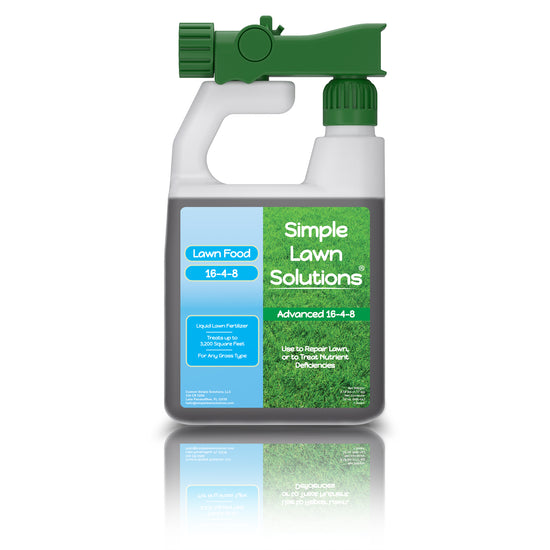
1. 16-4-8 Lawn Food (1 Gallon) — Best Spring & Fall Bermuda Fertilizer
NPK: 16-4-8 | $59.99 | Covers 12,800 sq ft
The 16-4-8 Lawn Food is the ideal all-in-one spring bermudagrass fertilizer. It delivers 16% nitrogen for green-up and growth, 4% phosphorus for strong root development as bermuda breaks dormancy, and 8% potassium for turf hardiness going into summer. It's also enhanced with seaweed (kelp) and fish emulsion.
Best for: Spring green-up (when soil temps hit 65°F), fall maintenance, newly established bermuda that needs root development support.
Coverage: 1 gallon covers 12,800 sq ft — enough for a large bermuda lawn through several applications. Other sizes: 32 ounces covers 3,200 square feet, 2.5 gallon covers 32,000 square feet.
2. 28-0-0 High Nitrogen Fertilizer (1 Quart) — Best Summer Bermuda Fertilizer
NPK: 28-0-0 | $23.99 | Covers 3,200 sq ft
The 28-0-0 is the top-performing bermudagrass fertilizer for peak summer growth. At 28% nitrogen (70% quick-release + 30% slow-release), it's formulated to push fast green-up while continuing to feed between applications. Bermuda at its most aggressive in June, July, and August needs this level of nitrogen to maintain density, color, and lateral spread.
Best for: Summer feeding when bermuda is at peak growth, correcting nitrogen deficiency mid-season, quick green-up before an event or after a period of drought stress recovery.
Coverage: 1 quart covers 3,200 sq ft. Other sizes: 32 ounce ready-to-use covers 3,200 square feet, 1 gallon covers 12,800 square feet, 2.5 gallon covers 32,000 square feet.
Note: Apply in the morning or evening, not during the hottest part of the day. Do not apply during drought stress when bermuda is not actively growing.
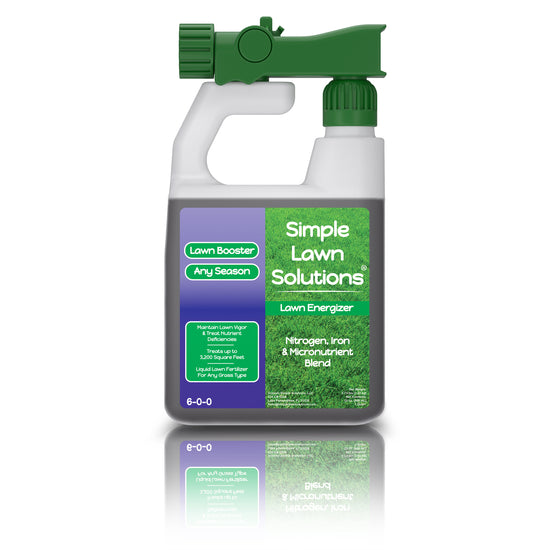
3. Lawn Energizer — Iron & Nitrogen Fertilizer (32 oz) — Best for Quick Greening
NPK: 6-0-0 | $24.99 | Covers 3,200 sq ft | Ready-to-Use Hose-End
Lawn Energizer is a chelated iron and nitrogen blend specifically designed to deepen lawn color fast. It contains 6% nitrogen, 5% chelated iron, 2.20% manganese, 2.75% sulfur, and 0.25% magnesium — a complete greening formula in one bottle. The ready-to-use hose-end design makes it the easiest product to apply: just attach to your hose and spray.
Best for: Fast color boost between regular fertilizer applications, correcting iron chlorosis (yellowing between leaf veins), pre-event green-up, or any time you want darker green color without pushing excessive growth.
Best results: Use Lawn Energizer every 3–4 weeks as a complement to your regular 28-0-0 or 16-4-8 program. The iron and micronutrients fill the color gap that pure nitrogen alone can't.
Browse the full Simple Lawn Solutions Bermudagrass Fertilizer collection for more options.
Common Bermudagrass Fertilizer Mistakes
There are several common mistakes can reduce fertilizer effectiveness or even damage the grass. Many of these issues stem from improper timing, incorrect application rates, or poor environmental conditions. Understanding these mistakes helps can help you maintain healthier turf and maximize fertilizer efficiency.
-
Applying Too Much Fertilizer
Overfertilization is one of the most common lawn care mistakes. Applying too much nitrogen can burn the lawn, increase susceptibility to pests and lawn diseases, cause nutrient runoff into nearby waterways, and increase too much top growth.
Always follow the label-recommended application rates and avoid the assumption that more fertilizer will produce better results.
Excess nitrogen can cause:
-
Leaf burn and turf injury
-
Excessive top growth requiring frequent mowing
-
Increased susceptibility to diseases and pests
-
Nutrient runoff into nearby waterways
2. Fertilizing at the Wrong Time of Year
Applying fertilizer when grass is not actively growing limits nutrient uptake and wastes product. Common mistakes include fertilizing warm-season grasses before the lawn is actively growing. For cool-season grass, applying heavy nitrogen during extreme summer heat can burn the lawn and stress the grass. Another common application timing mistake is fertilizing too late in fall, and stimulating growth too late in the fall when grass is starting to go dormant.
Examples include:
-
Fertilizing warm-season grasses before full spring green-up
-
Applying heavy nitrogen to cool-season grasses during summer heat
-
Late fall fertilization that stimulates growth before winter dormancy
3. Fertilizing During Heat or Drought Stress
Applying fertilizer when turf is already under stress can worsen damage. Applying during heat and drough stress can burn the lawn and cause browning. Fertilizing while the lawn is dormant is wasting nutrients and money as the lawn will not use nutrients while dormant.
Avoid fertilizing when:
-
Air temperatures exceed ~85–90°F for cool-season grasses
-
Temperatures exceed ~95–100°F for warm-season grasses
-
Turf shows wilting or drought stress
4. Applying Fertilizer to Dry or Dehydrated Soil
Dry soil limits nutrient absorption and can increase the risk of fertilizer injury. Ensure that the lawn has adequate soil moisture before application, and water in fertilizer to lawn as this helps move nutrients into the root zone for improved absorption.
Best practice:
-
Ensure the lawn has adequate soil moisture before application
-
Light watering after fertilizing can help move nutrients into the root zone (if not using foliar-only products)
5. Applying Fertilizer at the Wrong Time of Day
Applying fertilizer during the hottest part of the day can reduce effectiveness, due to evaporation. Applying in the hottest part of the day risks burning your lawn.
Apply liquid fertilizers:
-
Apply early morning or evening when temperatures are cooler
-
This improves foliar absorption and reduces evaporation or leaf burn
6. Uneven Fertilizer Application
It is crucial to use properly calibrated spreaders or sprayers when applying fertilizer. Do not overlap applications to ensure uniform coverage. Uneven coverage often leads to:
-
Dark green stripes or patches
-
Yellow areas where fertilizer was missed
-
Inconsistent turf growth
7. Ignoring Soil Test Results
Many homeowners fertilize without knowing their soil’s nutrient levels. A soil test every 2–3 years provides valuable guidance on nutrient needs and pH management.
This can lead to:
-
Overapplication of nutrients already present
-
Uncorrected soil pH issues, which can affect nutrient uptake and availability
-
Inefficient lawn care spending

Recommended Liquid Lawn Fertilizer for Bermudagrass
If you want a simple, effective solution, look for a liquid fertilizer designed specifically for bermudagrass or Southern lawns.
The best products will:
-
Be high in nitrogen
-
Include micronutrients like iron
-
Be easy to apply with a hose-end sprayer
Using the right product consistently is what turns an average lawn into a standout one.
FAQs About Bermudagrass Fertilizer
What fertilizer makes bermuda grass darker green?
High-nitrogen fertilizers with added iron will produce the deepest green color.
How often should I fertilize bermudagrass?
Every 2–4 weeks during the growing season for best results.
Can I use liquid fertilizer all season?
Yes—liquid fertilizer is ideal for consistent, season-long feeding.
What is the best NPK ratio for bermudagrass?
A nitrogen-heavy ratio, like 16-4-8 or similar works best.
Final Thoughts
If you want a thick, green bermudagrass lawn, the formula is simple:
-
Feed it regularly
-
Use high-nitrogen fertilizer
-
Apply it consistently
And if you want faster results with less guesswork, liquid lawn fertilizer is one of the best tools you can use. Start in spring, stay consistent through summer, and you’ll see the difference in just a few weeks.


1 comment
Best comprehensive article on Bermuda lawn care that i have found in years of trying to grow and maintain a good solid Bermuda lawn.