


Working hard to have a great lawn shows that you have pride in your home. Don’t let those hours spent in the heat working on your yard go to waste. Whether you're a lawn care expert or just getting started, there’s never a wrong time to learn more about lawn fertilizer.
Let’s Talk Liquid Fertilizer

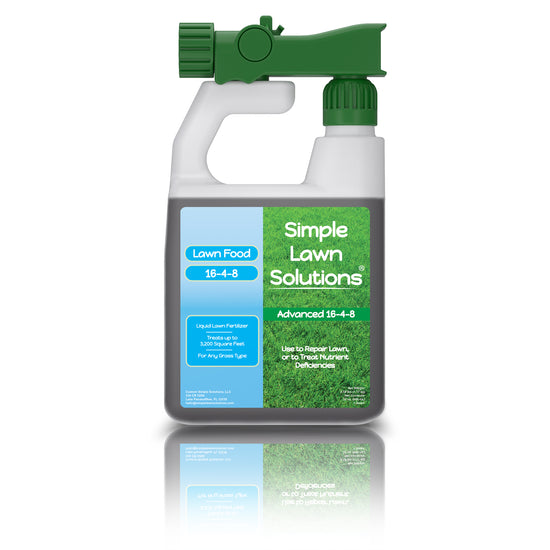
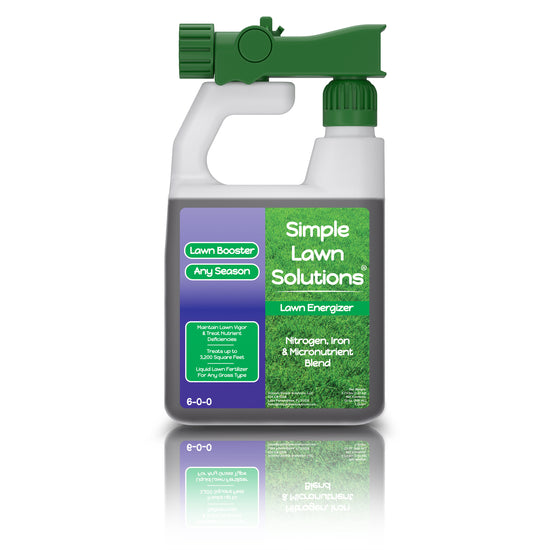
Simple Lawn Solutions has various specialty fertilizers that focus on grass growth, lawn strength, and root development. With the right fertilizer and proper grass care techniques, you will be on your way to green and growing grass. Here are just three reasons why we love liquid fertilizer:
- Easy-to-use (no spreading equipment required)
- Well-mixed nutrients for uniform application
- Fast results (if there is a nutrient deficiency)
Our lawn food provides a balanced amount of the macronutrients: nitrogen, phosphorus, and potassium. These nutrients are essential for grass health and vigor. Our liquid fertilizer is a homogeneous mixture, so there is an equal distribution of nutrients for your lawn during application. This fertilizer penetrates the ground, enabling the enhanced health of both your grass and soil.
Liquid fertilizer is safe for all grass types. Consider adding liquid fertilizer to your grass care routine and watch how quickly you see results!
When to Use Liquid Fertilizer
There are a few different factors to consider when deciding to fertilize your lawn, including climate and grass type.

First and foremost, a soil test should be conducted to help understand what your soil is already able to provide the plant. However, a general rule of thumb is that fertilization should take place twice a year, in spring and fall. At the minimum, you should fertilize your grass once a year. There are also visual ways to see if your lawn might benefit from increasing your fertilization frequency of liquid fertilizer:
- Thinning grass
- Chlorotic/yellow turf
- Patches
- Weed persistence
Keeping a close eye on how your lawn is responding to your grass care routine can help you to mitigate any issues before they get worse.
The Best Time to Fertilize
Knowing the best time to fertilize your lawn starts with understanding the type of grass you have. For different warm-season and cool-season grass species, the best time for fertilization will vary.

Warm-season grass is best fertilized in June and then again in August. Depending on the health of your grass, you may also want to reapply fertilizer in September or spot treat areas that need a little extra care.
Cool-season grass fertilization should take place in May and then be reapplied in September, or around six weeks before the first frost.
When it comes to lawn care, timing is everything. Knowing more about your grass type will help you better understand the best time for fertilization and help you plan out your fertilization lawn care routine for the year.
FAQs on Liquid Fertilizer
What is liquid lawn fertilizer?
Liquid lawn fertilizer is a water-soluble fertilizer solution applied through a hose-end sprayer or pump sprayer. It delivers nutrients directly to the soil and can also be absorbed through grass leaf surfaces, resulting in faster visible response than granular alternatives. Liquid formulas come in concentrated form that is diluted with water before application.
Is liquid fertilizer better than granular?
Liquid and granular fertilizers each have strengths. Liquid fertilizer acts faster, distributes more uniformly, and can be absorbed both through roots and leaf surfaces, making it ideal for quick corrections and routine feeding. Granular fertilizer releases nutrients more slowly, is easier to store and apply to large areas, and can be better for sustained slow-release feeding programs.
How do I apply liquid lawn fertilizer correctly?
Mix the concentrate with water at the recommended dilution rate in a hose-end or pump sprayer. Apply evenly across the lawn in a walking pattern, overlapping slightly between passes. Water in lightly after application to push nutrients into the root zone. Apply in the morning or evening when temperatures are cooler.
How often should liquid fertilizer be applied to a lawn?
Liquid fertilizers are typically applied every 3–6 weeks during the active growing season. The shorter intervals are suitable for light-rate applications focused on color maintenance, while the longer intervals apply to heavier feeding programs. Consistent, lower-rate applications generally produce better results than infrequent heavy ones.
Does liquid fertilizer expire or go bad?
Most liquid fertilizers have a shelf life of 2–5 years when stored properly, in a cool, dark location with the container sealed. Exposure to extreme heat, freezing, or prolonged light can degrade the product. Always check for separation, discoloration, or unusual smell before using older product. Concentrated liquid fertilizers should be stored per label instructions.


8 comments
Hello Beth,
The product’s shelf life is 2 years (from purchase). You have to shake the product well and store it in temps between 41 degrees F and 77 degrees F.
I bought your fertilizer not this summer but last summer is it still good to apply?
Hello Sean, for best results we recommend applying the soil loosener first, waiting approximately 1 week, and then applying the fertilizer and root hume. The soil loosener will help the fertilizer work its way deeper into the soil for better absorption! Hope this helps!
Is it safe to apply Root hume, soil loosener and the balanced liquid fert in the same application? If so, what is the order? Live in the PNW and have sod that was installed in the winter (6 months old). Thanks!
Hello Cheryl, Thank you for your comment! We would recommend applying the Root Hume to dry soil. Root Hume should be watered in to allow for better absorption. You can apply this product prior to the rain, but we would recommend holding off on applying any products if a heavy rainstorm is expected. A heavy rainstorm could wash away the product completely, especially if there is flooding. Feel free to email us if you have any additional questions or concerns at hello@simplelawnsolutions.com