
Fertilizing your lawn in spring is a crucial part of spring lawn care. Spring lawn fertilizer helps your lawn recover from winter dormancy, supports strong roots, turf resilience, and sets a foundation for lush, green growth. In this blog post we’ll cover why spring lawn fertilizer matters, when to apply lawn fertilizer, types of lawn fertilizers, what to apply, and common spring lawn fertilizer mistakes homeowners make.
Why Spring Lawn Fertilizer Matters
Spring lawn fertilizer provides crucial nutrients, including nitrogen, phosphorus, and potassium. These macronutrients improve turf density, support greening and growth, and help grass flourish. In the winter, your lawn goes dormant to survive, saving energy during cold temperatures. Even though the grass blades appear dead and brown, the roots remain alive, often protected by snow or soil, waiting for warmer weather in spring to turn green again. In the spring, as temperatures rise, your grass to wake up from winter dormancy looking for nutrients, sunlight, and water.
Spring lawn fertilization is an essential step to jumpstart grass growth after winter, strengthening roots, enhancing vibrant green color, and boosting density to naturally crowd out weeds. It prepares turf to endure summer stresses by replenishing nutrients, setting the foundation for a healthy, lush lawn all season.
Key Benefits of Spring Lawn Fertilization:
-
Jumpstart Recovery and Green-Up: Fertilization provides essential nutrients, such as nitrogen, phosphorus, and potassium to help the grass recover from winter damage, helping it grow thicker and greener faster.
-
Stronger Root System: Early, properly timed fertilizer application, especially with a phosphate fertilizer, supports deep turf roots. Stronger roots enable the grass to absorb water and nutrients more efficiently throughout the growing season.
-
Vigorous and Resilient Turf All Season: A lawn that is appropriately fertilized is more likely to withstand environmental stressors and dormancy.
-
Can Help Weed Prevention: A dense, well-fed lawn makes it difficult for weeds and crabgrass to take over, and can crowd out weeds.

When to Apply Spring Fertilizer (Timing Guide)
Early Spring vs Late Spring
The best timing for applying liquid lawn fertilizer depends on both the grass species (cool-season vs. warm-season) and the seasonal growth cycle of turfgrass. Liquid fertilizers act quickly because nutrients are readily available through foliar and soil uptake, so applications should align with periods of active growth and favorable environmental conditions.
Cool-season grasses (Kentucky bluegrass, perennial ryegrass, tall fescue):
Apply light liquid fertilization in mid to late spring once the turf has begun active growth and mowing has started regularly. Begin light liquid fertilization when soil temperatures consistently reach 50–55°F at a 2-inch depth. Avoid very early heavy feeding, which can encourage excessive top growth and reduce root development.
Warm-season grasses (Bermudagrass, zoysiagrass, centipedegrass, St. Augustinegrass):
Wait until the turf has fully greened up and soil temperatures reach ~65°F. Applying too early, while turf is still dormant, wastes nutrients and may stimulate weeds.
Signs Your Lawn Is Ready for Spring Fertilizer
Your lawn is ready for spring fertilizer when the grass turns from dormant brown to actively growing green, usually requiring its first mow. Key signs include green-up, thinning/bare spots, pale color, and weed emergence, typically signaling the need for nutrients.
Growth & Green-up: The grass is growing and needs to be mowed for the first time.
Soil Temperature (Best Indicator): Soil temperatures reach approximately 50°F–55°F at a depth of 2-3 inches, for cool-season grass, and ~65°F for warm-season grass.
Thinning or Bare Spots: The lawn is struggling to fill in, suggesting it needs nitrogen to encourage leaf growth.

The Types of Lawn Fertilizer: Explained
Granular vs Liquid Lawn Fertilizer
In terms of lawn care, plants need three basic nutrients for growth, root development, enhancing green, and strengthening. Those nutrients are nitrogen, phosphorus, and potassium. Both liquid lawn fertilizer and granular fertilizer contain these three main nutrients, and while a plant can’t tell the source of the nutrient, it could be sensitive to the rate and delivery method.
Most liquid lawn fertilizer delivers a quick release of nutrients, while granular fertilizer has a slow release for your plants. When comparing liquid lawn fertilizer to granular fertilizer, we can look at the difference in the distance from the fertilizer nutrients to the plant roots for absorption to take place. Phosphorus is not a very mobile nutrient, and it has a hard time moving from where the fertilizer was applied to the root of the plants. Liquid lawn fertilizers provide a better option for your grass, with nutrients quickly applied to the soil or directly to the leaves, resulting in easier plant absorption. Applying liquids directly to the leaf blades will allow for a more rapid response.
Most granular fertilizers are meant to be slow-release fertilizers. Granular fertilizers usually contain higher concentrations since the nutrients need to last longer. This high concentration also means granular fertilizer can have a higher salt content compared to liquid lawn fertilizer.

Best Spring Fertilizer Options (What to Apply)
Nitrogen-Rich Fertilizers (Most Important)
Nitrogen is the primary driver of turfgrass growth because it is a core component of:
-
Chlorophyll: directly affects green color and photosynthetic capacity
-
Amino acids and proteins: essential for leaf and tiller development
-
Enzymatic activity: supports metabolic recovery after winter stress
In early spring, cool-season grasses (e.g., Kentucky bluegrass, perennial ryegrass, tall fescue) are reallocating carbohydrate reserves from roots to shoots. A moderate nitrogen supply helps:
-
Restore canopy density
-
Improve color and visual uniformity
-
Support controlled tillering
However, excessive early N can:
-
Suppress root growth (due to shoot prioritization)
-
Increase mowing frequency unnecessarily
Best Simple Lawn Solutions Nitrogen Fertilizers for Spring
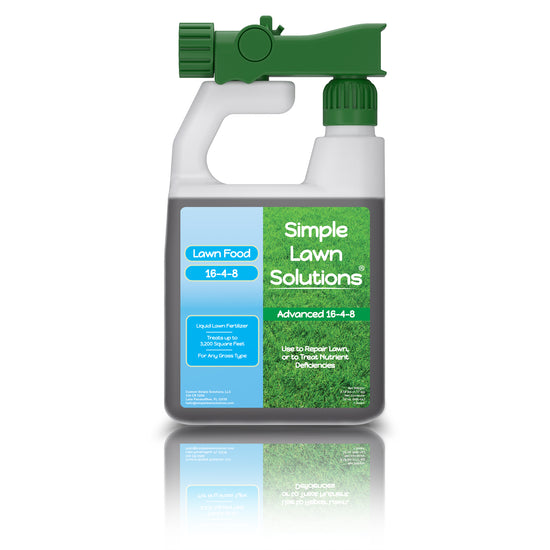
1. Advanced 16-4-8 Balanced Liquid Fertilizer
Benefits:
-
Provides 16% nitrogen without excessive surge growth
-
Includes phosphorus (4%) to support early root activity (useful in cold soils)
-
Potassium (8%) enhances stress tolerance and water regulation
Best use:
Early spring green-up when soil temperatures reach ~50–55°F.
2. High Nitrogen 28-0-0 Liquid Fertilizer
Benefits:
-
Rapid green-up
-
Strong response in turf color
Best use:
-
Mid-to-late spring after initial green-up
3. 15-0-15 Liquid Fertilizer (Nitrogen + Potassium)
Benefits:
-
Nitrogen promotes color and density
-
Potassium supports root function and turf resilience tolerance
-
No phosphorus (appropriate if soil P is already sufficient)
Best use:
Mid-spring maintenance, especially on established lawns with adequate soil phosphorus.

How to Apply Liquid Lawn Fertilizer (Step-by-Step)
Applying Simple Lawn Solutions ready-to-spray fertilizers make fertilzation simple. It is recommended to mow your lawn the day before or the day after fertilization, not on the same day. These directions apply to Simple Lawn Solutions’ Lawn Foods.
Simple Lawn Solutions’ Hose-end Sprayer Directions
-
Shake Simple Lawn Solutions’ products well.
-
Attach the spray nozzle to your garden hose.
-
Turn water on to a low to medium flow.
-
Turn the sprayer dial to the ‘ON’ position.
-
Apply product evenly, walking at a medium pace.
Other Hose-end Sprayer Directions (Ortho Sprayer)
-
Pour fertilizer into hose-end sprayer (ortho sprayer).
-
Set sprayer dial to the 3 ounces setting.
-
Evenly apply 10 ounces per 1,000 square feet to lawn.
Simple Lawn Solutions’ Tank/Backpack Sprayer Directions
-
Measure 4 ounces of fertilizer per 1 gallon of water.
-
Evenly apply per 1,000 square feet to lawn.
-
Best applied before 10 am or after 3 pm.
Common Spring Fertilizing Mistakes to Avoid
There are several common mistakes can reduce fertilizer effectiveness or even damage the grass. Many of these issues stem from improper timing, incorrect application rates, or poor environmental conditions. Understanding these mistakes helps can help you maintain healthier turf and maximize fertilizer efficiency.
-
Applying Too Much Fertilizer
Overfertilization is one of the most common lawn care mistakes. Applying too much nitrogen can burn the lawn, increase susceptibility to pests and lawn diseases, cause nutrient runoff into nearby waterways, and increase too much top growth.
Always follow the label-recommended application rates and avoid the assumption that more fertilizer will produce better results.
Excess nitrogen can cause:
-
Leaf burn and turf injury
-
Excessive top growth requiring frequent mowing
-
Increased susceptibility to diseases and pests
-
Nutrient runoff into nearby waterways
2. Fertilizing at the Wrong Time of Year
Applying fertilizer when grass is not actively growing limits nutrient uptake and wastes product. Common mistakes include fertilizing warm-season grasses before the lawn is actively growing. For cool-season grass, applying heavy nitrogen during extreme summer heat can burn the lawn and stress the grass. Another common application timing mistake is fertilizing too late in fall, and stimulating growth too late in the fall when grass is starting to go dormant.
Examples include:
-
Fertilizing warm-season grasses before full spring green-up
-
Applying heavy nitrogen to cool-season grasses during summer heat
-
Late fall fertilization that stimulates growth before winter dormancy
3. Fertilizing During Heat or Drought Stress
Applying fertilizer when turf is already under stress can worsen damage. Applying during heat and drought stress can burn the lawn and cause browning. Fertilizing while the lawn is dormant is wasting nutrients and money as the lawn will not use nutrients while dormant.
Avoid fertilizing when:
-
Air temperatures exceed ~85–90°F for cool-season grasses
-
Temperatures exceed ~95–100°F for warm-season grasses
-
Turf shows wilting or drought stress
4. Applying Fertilizer to Dry or Dehydrated Soil
Dry soil limits nutrient absorption and can increase the risk of fertilizer injury. Ensure that the lawn has adequate soil moisture before application, and water in fertilizer to lawn as this helps move nutrients into the root zone for improved absorption.
Best practice:
-
Ensure the lawn has adequate soil moisture before application
-
Light watering after fertilizing can help move nutrients into the root zone (if not using foliar-only products)
5. Applying Fertilizer at the Wrong Time of Day
Applying fertilizer during the hottest part of the day can reduce effectiveness, due to evaporation. Applying in the hottest part of the day risks burning your lawn.
Apply liquid fertilizers:
-
Apply early morning or evening when temperatures are cooler
-
This improves foliar absorption and reduces evaporation or leaf burn
6. Uneven Fertilizer Application
It is crucial to use properly calibrated spreaders or sprayers when applying fertilizer. Do not overlap applications to ensure uniform coverage. Uneven coverage often leads to:
-
Dark green stripes or patches
-
Yellow areas where fertilizer was missed
-
Inconsistent turf growth
7. Ignoring Soil Test Results
Many homeowners fertilize without knowing their soil’s nutrient levels. A soil test every 2–3 years provides valuable guidance on nutrient needs and pH management.
This can lead to:
-
Overapplication of nutrients already present
-
Uncorrected soil pH issues, which can affect nutrient uptake and availability
-
Inefficient lawn care spending

Pro Tips for a Healthier Lawn All Season
1. Spring = Green-up timing differs
-
Cool-season (KBG, rye, fescue):
Light nitrogen early (soil ~50–55°F). Focus on recovery, not surge growth. -
Warm-season (Bermuda, zoysia, St. Augustine):
Wait until full green-up before applying nitrogen. Fertilizing too early wastes N and can encourage weeds.
Key takeaway:
Cool-season = early light feeding
Warm-season = delay until active growth
2. Summer = Growth vs. Survival Mode
-
Cool-season:
Enters stress period. Minimize nitrogen, raise mowing height, prioritize irrigation and potassium. -
Warm-season:
Peak growth period. This is when you can push nitrogen more aggressively and expect strong response.
Key takeaway:
Cool-season = protect
Warm-season = promote
3. Fall = Opposite priorities
-
Cool-season:
Primary fertilization window. Apply the most nitrogen of the year to drive root growth and carbohydrate storage. -
Warm-season:
Begin tapering nitrogen. Too much late N reduces winter hardiness.
Key takeaway:
Cool-season = build and store
Warm-season = prepare for dormancy
4. Mowing strategy shifts with growth habit
-
Cool-season:
Maintain 3–4 inches to support deeper roots and stress tolerance. -
Warm-season:
Generally lower heights (0.5–2 inches, species-dependent) to match stoloniferous/rhizomatous growth.
Key takeaway:
Cool-season = taller canopy
Warm-season = lower, more frequent mowing
5. Watering principles are similar—but outcomes differ
-
Both types:
Deep, infrequent irrigation (~1–1.5 inches/week total) -
Cool-season:
More prone to heat/drought stress—monitor closely in summer -
Warm-season:
More drought-tolerant but still benefits from consistent deep watering for optimal performance
Key takeaway:
Same method, different tolerance levels
Bottom line
-
Cool-season turf thrives in spring and fall → manage for recovery and storage
-
Warm-season turf thrives in late spring and summer → manage for active growth and density
Understanding when the plant is biologically “on” vs. “off” is the biggest separator between average and high-level turf management.
Frequently Asked Questions (FAQs)
1. What fertilizer should I apply in spring for my lawn?
The best spring lawn fertilizer is a nitrogen-rich fertilizer that supports green-up and early growth. A balanced liquid lawn fertilizer (such as 16-4-8) is ideal in early spring because it provides nitrogen for color, phosphorus for root development, and potassium for stress tolerance. Avoid heavy nitrogen applications too early, as they can lead to excessive leaf growth and weaker roots.
2. When should I apply spring lawn fertilizer?
Spring lawn fertilizer should be applied when your grass is actively growing and soil temperatures reach 50–55°F for cool-season lawns and ~65°F for warm-season lawns. Liquid lawn fertilizer works quickly, so proper timing is critical to maximize nutrient uptake and avoid waste.
3. Is liquid lawn fertilizer better than granular fertilizer in spring?
Liquid lawn fertilizer is often preferred in spring because it provides quick nutrient availability through both foliar and soil uptake, leading to faster green-up. Granular fertilizers release nutrients more slowly, which can be beneficial for long-term feeding, but liquids offer more precise control and faster results during the spring transition.
4. How often should I apply liquid fertilizer in spring?
Most lawns benefit from light, frequent applications of liquid lawn fertilizer every 2–4 weeks during active spring growth. Applying smaller amounts of nitrogen improves nutrient efficiency, reduces surge growth, and promotes a more consistent, healthy lawn.
5. Can spring lawn fertilizer help prevent weeds?
Yes, a properly fertilized lawn becomes denser and more competitive, which helps crowd out weeds like crabgrass. While spring fertilizer is not a herbicide, maintaining thick, healthy turf with proper spring grass fertilizer applications is a key part of natural weed prevention.