
A healthy green lawn does not come from applying more fertilizer. It comes from applying the right fertilizer, at the right time, at the right rate, under the right conditions. Many lawn problems blamed on “bad fertilizer” are actually caused by application mistakes such as fertilizing dormant grass, using too much nitrogen, applying fertilizer during extreme heat, failing to water in products correctly, or spreading fertilizer unevenly.
The good news is that most of these mistakes are easy to avoid. If you want your lawn fertilizer to work more effectively and reduce the risk of turf injury, start by avoiding these common fertilization errors.

1. Fertilizing Dormant Grass
One of the most common lawn fertilizing mistakes is applying fertilizer simply because the grass looks brown. Brown grass is not always hungry grass. Turf can turn brown or lose color because of:
-
Drought
-
Extreme heat
-
Cold temperatures
-
Seasonal dormancy
-
Disease
-
Insect damage
-
Root problems
-
Poor irrigation
Grass dormancy is often a survival response. Warm-season grasses such as bermudagrass and zoysiagrass may go dormant during cold weather. Cool-season grasses can slow dramatically during extreme summer heat or drought. Even drought-tolerant warm-season grasses can lose color when soil moisture becomes too limited.
Should You Fertilize Dormant Grass?
Usually, you should avoid heavy fertilizer applications when turf is truly dormant or severely stressed. If the grass is not actively growing, it may not be able to use nutrients efficiently. That means adding fertilizer may do little to improve color and can increase the risk of nutrient loss or turf injury. If the problem is drought, heat, dormancy, or disease, fertilizer may not be the solution.
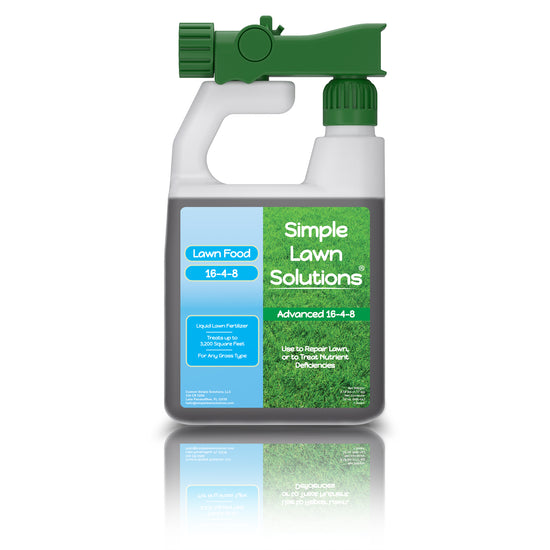
Product Highlight: 16-4-8 Complete N-P-K Lawn Food
When your lawn is actively growing, and your fertility program calls for nitrogen, phosphorus, and potassium, Simple Lawn Solutions 16-4-8 provides a balanced N-P-K option.
Shop 16-4-8 Complete N-P-K Lawn Food →
2. Fertilizing During Extreme Heat
Another common mistake is applying fertilizer during the hottest part of the day. Hot, dry weather already places grass under stress. Applying fertilizer during extreme heat can increase the chance of:
-
Leaf injury
-
Fertilizer burn
-
Rapid drying
-
Poor nutrient uptake
-
Additional stress on the plant
Many fertilizers contain soluble salts. When applied at high rates or under dry conditions, those salts can contribute to osmotic stress around the plant. That is one reason fertilizer applications should be made carefully during periods of high heat and low soil moisture.
What Is the Best Time of Day to Fertilize a Lawn?
If you are applying fertilizer during warm weather, cooler parts of the day are generally preferable. Early morning is often a good option because:
-
Temperatures are lower
-
Evaporation is reduced
-
Grass is less heat-stressed
-
Irrigation can often be applied afterward if needed
Late afternoon may also be suitable depending on the product and weather but the product label guidance should always take priority.

3. Applying Too Much Fertilizer
More fertilizer does not mean a greener or healthier lawn.
Overfertilization can cause:
-
Fertilizer burn
-
Excessive shoot growth
-
Increased mowing
-
Thatch accumulation
-
Nutrient imbalance
-
Nutrient runoff or leaching
-
Increased disease susceptibility in some situations
This is especially important with high-nitrogen fertilizer.
How Much Fertilizer Should You Apply?
The correct amount depends on:
-
Product analysis
-
Application rate
-
Lawn size
-
Grass species
-
Growth stage
-
Soil fertility
-
Season
-
Local recommendations
Always calculate fertilizer based on square footage rather than guessing. If a label says one container covers 3,200 square feet, do not use the entire container on 1,500 square feet simply because you want faster results.
4. Not Measuring Your Lawn Before Fertilizing
One of the easiest ways to accidentally overfertilize is not knowing how large your lawn actually is. Before applying fertilizer, estimate or measure the square footage of the turf area.
Do not include:
-
Driveways
-
Sidewalks
-
Patios
-
Mulch beds
-
Swimming pools
-
Buildings
Knowing the actual lawn area helps you apply the correct amount of product.
Simple Formula for Determining the Correct Lawn Square Footage
For a rectangular area:
Length × Width = Square Feet
For irregular lawns, divide the yard into smaller sections, calculate each one, and add them together.

5. Not Watering Fertilizer Correctly
Whether fertilizer should be watered in depends heavily on the product. This is especially important with granular fertilizers. Certain nitrogen sources, including urea, can lose nitrogen through ammonia volatilization under some conditions. Incorporating the fertilizer with irrigation or rainfall can reduce those losses.
Should You Water After Applying Granular Fertilizer?
Often, yes. Many granular fertilizers are designed to be watered into the soil.
Water helps:
-
Move nutrients off the leaf surface
-
Dissolve fertilizer granules
-
Move nutrients toward the root zone
-
Reduce some nitrogen losses
However, always follow the product label.
Should You Water After Liquid Fertilizer?
Not always. Some liquid fertilizers are intended primarily for soil uptake and may benefit from irrigation after application. Others may be designed in part for foliar uptake. Micronutrients such as iron can sometimes be effective when applied to leaf tissue. Because liquid fertilizers vary, do not assume every liquid product should be watered in the same way. Follow the label for the specific fertilizer you are using.
6. Fertilizing Before Heavy Rain
Applying fertilizer immediately before a major storm can waste nutrients. Heavy rain can move fertilizer:
-
Off the lawn
-
Into storm drains
-
Into nearby waterways
-
Down slopes
-
Into low areas
Light irrigation may sometimes be useful for moving fertilizer into the soil, but heavy rainfall can increase runoff.
Should You Fertilize Before Rain?
A light, predictable rainfall event may sometimes help with fertilizer incorporation. A thunderstorm or several inches of rain is different. If heavy rainfall is expected, it is usually better to delay the application.

7. Fertilizing in Winter or Too Late in the Season
Late-season fertilizer timing can be confusing because there is no single cutoff date for every lawn.
The right timing depends on:
-
Grass type
-
Climate
-
Latitude
-
Soil temperature
-
Whether the grass is still growing
-
Fertilizer formulation
Warm-Season Grass
If warm-season grass has gone dormant after frost and lost its green color, the main growing-season fertilizer window has generally passed. Heavy nitrogen applications to dormant warm-season turf are usually not appropriate.
Cool-Season Grass
Cool-season lawns may remain active late into fall. However, late-fall fertilizer timing should be based on local turf recommendations rather than an arbitrary calendar date. Certain disease concerns, including snow mold in colder climates, may influence late-season nitrogen decisions. The safest approach is to follow guidance from your local university Extension program.
8. Fertilizing Drought-Stressed Grass
A drought-stressed lawn often looks weak, thin, or brown. That makes fertilizer tempting. But a severely drought-stressed lawn usually needs water and relief from stress before it needs additional fertilizer.
Should You Fertilize During a Drought?
Avoid heavy fertilizer applications to severely drought-stressed or dormant turf.
Wait until:
-
Soil moisture improves
-
The lawn resumes active growth
-
Environmental stress decreases
-
The grass can use the nutrients

9. Applying Fertilizer Unevenly
Uneven fertilizer application can create:
-
Dark green stripes
-
Yellow streaks
-
Burned patches
-
Missed areas
-
Overlap zones
The only stripes you want in your lawn should come from mowing—not fertilizer.
How to Apply Lawn Fertilizer Evenly
A few simple strategies can help:
-
Calibrate your spreader or sprayer
-
Keep walking speed consistent
-
Maintain even overlap
-
Use marker lines when necessary
-
Avoid stopping the spreader over the lawn
-
Apply half the rate in one direction and half perpendicular to it when appropriate
This cross-pattern method can improve coverage and reduce streaking.
10. Using the Wrong Fertilizer for the Lawn's Needs
Not every lawn needs the same fertilizer. A product with a high nitrogen analysis may be useful when nitrogen is the primary need. A complete N-P-K fertilizer may make sense when the lawn needs multiple macronutrients. A high-phosphorus fertilizer may be appropriate during establishment or when soil testing confirms a need.

Product Guide: Which Simple Lawn Solutions Fertilizer Fits Your Goal?
|
Lawn Goal |
Product to Consider |
|
General N-P-K nutrition |
|
|
Primarily nitrogen |
|
|
Phosphorus and potassium needs |
|
|
Nitrogen + phosphorus |
28-0-0 High Nitrogen Lawn Food
Simple Lawn Solutions 28-0-0 supplies nitrogen without phosphate or potash.
Best fit: Actively growing grass where supplemental nitrogen is appropriate.
16-4-8 Complete N-P-K
Simple Lawn Solutions 16-4-8 provides nitrogen, phosphate, and potash.
Best fit: Situations where all three primary fertilizer nutrients are appropriate.
3-18-18 High Phosphorus & Potassium
Simple Lawn Solutions 3-18-18 provides relatively high phosphate and potash.
Best fit: Lawns where phosphorus and potassium are needed based on soil conditions or a fertility program.
6-18-0 Growth Booster
Simple Lawn Solutions 6-18-0 Growth Booster supplies nitrogen and phosphate.
Best fit: Situations where phosphorus is appropriate and some nitrogen is also desired.
Frequently Asked Questions About Lawn Fertilizer Mistakes
Can you fertilize a dormant lawn?
Usually, heavy fertilizer applications should be avoided when turf is truly dormant. Wait until the grass resumes active growth unless local turf recommendations indicate otherwise.
Should I fertilize brown grass?
Not automatically. Brown grass may be dormant, drought-stressed, heat-stressed, diseased, or damaged. Identify the cause before applying fertilizer.
Can fertilizer burn grass?
Yes. Fertilizer burn can occur when soluble salts become too concentrated around plant tissue, especially from overapplication, dry soil, or inappropriate application conditions.
What happens if you put too much fertilizer on grass?
Overfertilization can cause leaf burn, excessive growth, nutrient imbalance, increased water demand, and nutrient losses.
Should I fertilize my lawn in hot weather?
Use caution. Avoid heavy fertilizer applications when turf is severely heat-stressed, especially if soil moisture is limited.
What is the best time of day to fertilize a lawn?
Cooler periods, such as early morning, are often preferable during warm weather, but the fertilizer label should guide application conditions.
Should I water after applying fertilizer?
Often, but it depends on the product. Many granular fertilizers should be watered in, while some liquid fertilizers may have different instructions.
How long after fertilizing should I water?
Follow the product label. Some fertilizers should be watered in soon after application, while others are intended to remain on foliage for a period of time.
Can I fertilize before it rains?
Light rainfall may help move fertilizer into the soil, but avoid applying fertilizer immediately before heavy rainfall that can cause runoff.
Can I fertilize during a drought?
Heavy fertilizer applications are generally not appropriate for severely drought-stressed or dormant turf. Wait for adequate moisture and active growth.
Should I fertilize in winter?
That depends on the grass type and climate. Dormant warm-season lawns usually do not need regular growing-season fertilizer. Cool-season late-fall programs vary by region.
Is liquid fertilizer safer than granular fertilizer?
Not automatically. Both can injure turf if overapplied or used under unsuitable conditions. Proper rate, timing, and label directions matter more than fertilizer form.
How do I prevent fertilizer stripes?
Apply fertilizer uniformly, calibrate equipment, maintain consistent walking speed, and consider applying partial rates in perpendicular directions.
What fertilizer makes grass green?
Nitrogen and iron are the nutrients most strongly associated with turfgrass color and shoot growth.
Is 28-0-0 fertilizer good for grass?
28-0-0 is a high-nitrogen fertilizer that can be useful when actively growing turf needs nitrogen. It is not automatically appropriate for dormant, drought-stressed, or nutrient-balanced lawns.
Is 16-4-8 fertilizer good for lawns?
16-4-8 supplies all three primary fertilizer nutrients and can be appropriate when nitrogen, phosphorus, and potassium are all needed.
Should I soil test before fertilizing?
Soil testing is especially helpful for evaluating pH, phosphorus, potassium, and amendment needs. It can help prevent unnecessary fertilizer applications.
Fertilizer Works Best When the Lawn Is Ready for It
Most fertilizer mistakes have one thing in common: The product is being applied without considering whether the lawn is actually ready to use it.
Before you fertilize, ask:
-
Is the grass actively growing?
-
Is the lawn adequately watered?
-
Is the turf under heat or drought stress?
-
Do I know the lawn's square footage?
-
Am I using the correct rate?
-
Does the lawn actually need these nutrients?
-
Do I need to water the product in?
-
Is heavy rain expected?
-
Am I applying it evenly?
Fertilize With More Confidence
Simple Lawn Solutions offers liquid lawn fertilizers for different nutrient goals, from high-nitrogen feeding to complete N-P-K nutrition.
Not sure which product matches your lawn?
Take the Simple Lawn Solutions Lawn Quiz → to narrow down your options and build a lawn-care plan around your grass, soil, and growing conditions.
Extension References
-
Purdue University Turfgrass Science
https://turf.purdue.edu/ -
Penn State Extension — Turfgrass & Lawn Care
https://extension.psu.edu/trees-lawns-and-landscaping/turfgrass-and-lawn-care -
University of Minnesota Extension — Lawn Care
https://extension.umn.edu/lawn-care -
University of Maryland Extension — Lawns
https://extension.umd.edu/resource/lawns/ -
NC State Extension — TurfFiles
https://www.turffiles.ncsu.edu/ -
Clemson Cooperative Extension — Lawns
https://hgic.clemson.edu/category/lawns/ -
University of Florida IFAS — Lawn Care
https://gardeningsolutions.ifas.ufl.edu/lawns/ -
University of Nebraska–Lincoln Turfgrass
https://turf.unl.edu/ -
U.S. Environmental Protection Agency — Nutrient Pollution
https://www.epa.gov/nutrientpollution