
Phosphorus helps grass develop roots, establish new growth, transfer and store energy, and support essential processes within the plant. It is especially important when grass is establishing from seed or sod and when a soil test shows that an existing lawn is deficient in phosphorus.
But that doesn't mean every lawn needs more phosphorus.
Unlike nitrogen, phosphorus generally shouldn't be applied to an established lawn simply because you want greener or faster-growing grass. A soil test is the best way to determine whether your lawn actually needs phosphorus fertilizer. Phosphorus use on lawns is restricted in some areas because excess phosphorus entering waterways can contribute to water-quality problems.
Understanding what phosphorus does and when your grass actually needs it can help you choose the right lawn fertilizer.
What Does Phosphorus Do for Grass?
Phosphorus (P) is one of the three primary macronutrients associated with lawn fertilizers, along with nitrogen (N) and potassium (K).
In grass plants, phosphorus plays important roles in:
-
Root growth and development
-
Energy transfer and storage
-
Cell division and growth
-
Seedling establishment
-
Overall plant development
Phosphorus can be particularly important during early grass development, when new plants are building the root systems needed to become established. That is one reason phosphorus is commonly associated with starter fertilizers for new grass.
However, an established lawn with adequate soil phosphorus may see little benefit from additional phosphorus. The goal is to ensure the plant has access to the amount it needs.
5 Benefits of Phosphorus Fertilizer for Grass
When a lawn needs phosphorus, applying an appropriate phosphorus fertilizer can provide several benefits.
1. Supports Root Development
One of phosphorus's best-known functions in turfgrass is its role in root development. A developing grass plant needs a healthy root system to anchor itself in the soil and access water and nutrients. Phosphorus is therefore particularly important during establishment.
This makes phosphorus fertilizer especially relevant when:
-
Starting a lawn from seed
-
Establishing new sod
-
Planting grass plugs
-
Renovating or overseeding a lawn
-
Correcting a phosphorus deficiency confirmed by soil testing
Established lawns with sufficient phosphorus don't necessarily develop better roots simply because additional phosphorus is applied.
2. Helps New Grass Establish
New grass seedlings have a lot of growing to do. Phosphorus supports the processes involved in early plant growth and root development, making adequate phosphorus particularly important during lawn establishment.
If you're preparing to seed or sod an area, a soil test before planting can tell you whether phosphorus is needed and help you select an appropriate starter fertilizer.
3. Supports Energy Transfer Within the Grass Plant
Phosphorus isn't just a "root nutrient." It is involved in the plant's systems for storing and transferring energy. Grass uses that energy to carry out fundamental biological processes necessary for growth and development.
This is one reason phosphorus is classified as an essential plant macronutrient, even though turfgrass generally requires less of it than nitrogen.
4. Supports Cell Division and Plant Growth
Growing grass constantly produces new cells.
Phosphorus participates in processes related to cell division and plant development. When phosphorus availability is insufficient, normal growth can be impaired.
5. Supports Healthy Seedling Development
Phosphorus is particularly relevant during germination and early establishment. Adequate phosphorus allows developing seedlings to build roots and establish themselves. That's why phosphorus is often found in starter lawn fertilizers intended for seeding and establishment.
Does Phosphorus Make Grass Green?
This is an important distinction. Phosphorus is not primarily the nutrient responsible for the rapid green-up homeowners commonly associate with lawn fertilizer. Nitrogen has a much more direct relationship with turfgrass color and shoot growth.
Phosphorus supports energy transfer, root development, and plant establishment. If your primary goal is making an otherwise healthy lawn greener, don't assume a high-phosphorus fertilizer is the answer. First, determine what the lawn actually needs.
How Do You Know if Your Lawn Needs Phosphorus?
The best answer is straightforward: Get a soil test.
Visual symptoms can sometimes provide clues, but they aren't a reliable substitute for testing, because lawn problems can have many causes. A laboratory soil test can tell you whether soil phosphorus is low and provide fertilizer recommendations based on the results.
Soil testing becomes particularly important with phosphorus because unnecessary applications may offer little turf benefit while increasing the amount of phosphorus that can potentially leave the lawn.
Possible Signs of Phosphorus Deficiency in Grass
Phosphorus-deficient grass can exhibit symptoms including:
-
Slow or stunted growth
-
Reduced turf vigor
-
Poor root development
-
Thinning turf
-
Unusual dark-green coloration
-
Reddish or purplish coloration under some conditions
Phosphorus deficiency can interfere with normal growth because the plant doesn't have adequate phosphorus to support essential metabolic functions. However, don't diagnose phosphorus deficiency by color alone.
Temperature, soil conditions, disease, other nutrient deficiencies, root problems, and environmental stresses can produce symptoms that homeowners may mistake for a fertilizer deficiency. Use symptoms as a reason to investigate, not as proof that you need phosphorus fertilizer.

What Do the Numbers on Phosphorus Fertilizer Mean?
Understanding the fertilizer label makes choosing a Phosphorus lawn fertilizer much easier. Most lawn fertilizers display three prominent numbers, such as:
16-4-8
or
3-18-18
These are commonly called the N-P-K numbers. They represent the fertilizer's guaranteed percentages by weight of:
-
Nitrogen (N)
-
Available phosphate (P₂O₅)
-
Soluble potash (K₂O)
So phosphorus is represented by the middle number on the fertilizer label.
For example:
3-18-18 = 3% nitrogen, 18% available phosphate, and 18% soluble potash.
16-4-8 = 16% nitrogen, 4% available phosphate, and 8% soluble potash.
This distinction is useful because not every fertilizer containing phosphorus is a high-phosphorus fertilizer.

When Should You Apply Phosphorus Fertilizer to Your Lawn?
There isn't one universal time when every lawn should receive phosphorus. Apply phosphorus when soil testing and your lawn's circumstances indicate that it is needed, and follow applicable fertilizer regulations and product directions.
Before Seeding a New Lawn
Lawn establishment is one of the most important times to evaluate soil phosphorus. Because phosphorus supports early root development and seedling establishment, correcting a confirmed deficiency before or during establishment can help new grass develop properly.
Testing the soil before planting also gives you an opportunity to address other nutrient or soil issues before the lawn becomes established.
When Installing Sod
New sod needs to establish roots into the underlying soil. If testing indicates insufficient phosphorus, an appropriate phosphorus-containing fertilizer can be incorporated into your establishment program.
When Overseeding or Renovating a Lawn
Overseeding introduces new grass seedlings into an existing lawn. Those seedlings have similar establishment requirements to other new grass, making phosphorus status worth considering as part of your renovation plan.
However, overseeding by itself doesn't necessarily mean you should automatically apply phosphorus. Soil conditions and local fertilizer regulations still matter.
When a Soil Test Shows a Phosphorus Deficiency
This is the clearest situation. If testing confirms that phosphorus is below the recommended range for your turf and soil, choose a fertilizer capable of supplying the recommended amount.

Should You Apply Phosphorus Fertilizer in Spring?
Spring isn't automatically "phosphorus season." Grass growth resumes during spring in many climates, but the fact that grass is growing doesn't necessarily mean the soil needs additional phosphorus.
If a soil test shows adequate phosphorus, adding more simply because spring has arrived may provide little benefit. If phosphorus is deficient, however, follow the soil-test recommendation and select an appropriate product and application timing for your turfgrass and location. The same principle applies in fall: fertilize according to your lawn's needs rather than assuming every lawn requires a seasonal phosphorus application.
Is Phosphorus Fertilizer Good for Established Lawns?
It can be, when the lawn needs phosphorus. Mature lawns with adequate soil phosphorus may receive little or no benefit from additional phosphorus applications.
An established lawn with a confirmed phosphorus deficiency is a different situation. Correcting that deficiency can restore an essential nutrient the grass needs for normal plant processes. This is why routine soil testing is so valuable. It replaces guesswork with actual information about your soil.
Can Too Much Phosphorus Hurt Your Lawn?
Applying more phosphorus than your lawn needs can create problems.
Environmental Concerns
Phosphorus that leaves a lawn and enters lakes, ponds, rivers, or streams can contribute to excessive aquatic plant and algae growth.
This is one reason responsible phosphorus use is important—and why some states and municipalities regulate phosphorus-containing lawn fertilizers.
Keep fertilizer off sidewalks, driveways, streets, and other hard surfaces where granules or liquid may be carried into storm drains and waterways.
Nutrient Imbalances
Excessive phosphorus in soil can also affect nutrient availability and contribute to imbalances involving micronutrients.
More fertilizer does not necessarily mean healthier grass.
The goal of fertilization is nutrient balance, not maximum nutrient application.
Unnecessary Expense
If your soil already contains sufficient phosphorus, applying additional phosphorus may simply mean paying for a nutrient the lawn doesn't need.
A soil test can help you spend your fertilizer budget where it can actually benefit your lawn.
Phosphorus Fertilizer Regulations: Check Before You Apply
Phosphorus deserves some additional attention because lawn-fertilizer regulations vary by location.
Some states and municipalities restrict phosphorus fertilizer use on established turf unless certain conditions are met, such as a soil test showing a need or the fertilizer being used during new lawn establishment.
Rules can differ considerably by location.
Before applying a phosphorus-containing lawn fertilizer:
-
Check your local and state fertilizer regulations.
-
Get a soil test when appropriate or required.
-
Read and follow the fertilizer label.
-
Apply only the amount needed.
-
Keep fertilizer away from hard surfaces and waterways.
Responsible fertilizer use is better for your lawn, your wallet, and the environment.
Choosing the Right Phosphorus Fertilizer for Your Lawn
If your soil test indicates your lawn would benefit from phosphorus, the next step is choosing a fertilizer that matches your needs.
Simple Lawn Solutions offers several liquid lawn fertilizers containing phosphorus, but they aren't interchangeable. The right choice depends on whether phosphorus is your primary target or whether you're looking for more balanced lawn nutrition.

3-18-18 High Phosphorus & Potassium Liquid Lawn Fertilizer
If you're specifically looking for a high-phosphorus liquid fertilizer, Simple Lawn Solutions 3-18-18 contains a higher proportion of phosphorus and potassium relative to nitrogen.
Its N-P-K analysis is:
3% nitrogen – 18% phosphate – 18% potash
This makes 3-18-18 an option to consider when soil testing indicates phosphorus is needed and your lawn-care program calls for relatively little nitrogen.
Best fit: Lawns needing phosphorus and potassium without a large nitrogen application, subject to soil-test recommendations and local fertilizer regulations.
Shop 3-18-18 High Phosphorus & Potassium Fertilizer →
6-18-0 Growth Booster
Simple Lawn Solutions 6-18-0 Growth Booster combines nitrogen with a relatively high phosphate analysis.
Its analysis is:
6% nitrogen – 18% phosphate – 0% potash
This provides another option when phosphorus is part of the lawn's nutrient needs and additional nitrogen is also appropriate.
Best fit: Situations where a lawn-care program calls for phosphorus along with some nitrogen.
16-4-8 Complete N-P-K Liquid Lawn Fertilizer
Not every lawn that needs some phosphorus needs a high-phosphorus fertilizer.
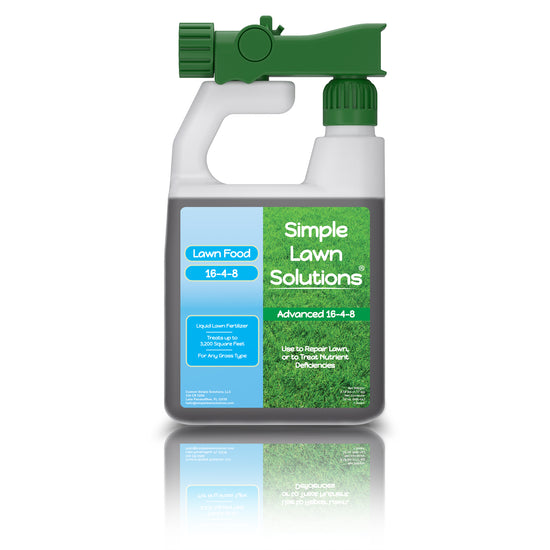
Simple Lawn Solutions 16-4-8 supplies all three primary fertilizer nutrients with substantially more nitrogen than phosphorus.
Its analysis is:
16% nitrogen – 4% phosphate – 8% potash
This makes it better suited to situations where the objective is broader N-P-K fertilization rather than making phosphorus the primary nutrient application.
Best fit: General lawn nutrition when nitrogen, phosphorus, and potassium are all appropriate based on your lawn's needs.
Shop 16-4-8 Complete N-P-K Lawn Food →
High-Phosphorus Fertilizer vs. Balanced Fertilizer
Not sure which type makes sense? Think about the objective rather than simply choosing the product with the largest numbers.
|
Lawn Goal |
Fertilizer Approach to Consider |
|
Correct a confirmed phosphorus need |
Higher-phosphorus fertilizer |
|
Establish new grass where phosphorus is needed |
Phosphorus-containing establishment fertilizer |
|
Supply N, P, and K as part of general fertility |
Balanced/complete N-P-K fertilizer |
|
Primarily encourage green shoot growth |
Evaluate nitrogen needs |
|
Soil already has adequate phosphorus |
Consider a low- or zero-phosphorus fertilizer |
A soil test should guide the decision whenever possible, particularly before intentionally selecting a high-phosphorus lawn fertilizer.
Give Your Grass the Phosphorus It Needs
Phosphorus is essential for healthy grass. It supports root development, seedling establishment, energy transfer, cell division, and other processes grass needs to grow. Those benefits can make phosphorus particularly important for new lawns and soils with confirmed phosphorus deficiencies.
But phosphorus fertilizer isn't something every established lawn needs every year. Test your soil first. Then choose a fertilizer based on what your grass actually needs. If testing indicates phosphorus should be part of your lawn-care program, compare Simple Lawn Solutions' phosphorus-containing liquid fertilizers to find the N-P-K analysis that best matches your lawn.
Explore Simple Lawn Solutions Lawn Fertilizers →
FAQs
What does phosphorus do for lawns?
Phosphorus is an essential plant nutrient involved in root development, energy transfer, cell division, photosynthesis, and overall plant growth. It is particularly important during seedling development and lawn establishment.
Is phosphorus good for grass roots?
Yes. Adequate phosphorus supports root development, which is particularly important for seedlings and newly establishing turf. However, adding phosphorus to soil that already contains enough doesn't necessarily create additional root growth.
Does phosphorus make grass greener?
Phosphorus contributes to overall plant health, but nitrogen is much more closely associated with turfgrass color and shoot growth. Don't use high-phosphorus fertilizer simply as a lawn "green-up" product unless phosphorus is actually needed.
What fertilizer is high in phosphorus?
Look at the middle number of the fertilizer's N-P-K analysis. A product such as 3-18-18 or 6-18-0 has a relatively high phosphate analysis because the middle number is 18.
What is the best phosphorus fertilizer for lawns?
There isn't one best phosphorus fertilizer for every lawn. The appropriate product depends on soil-test results, grass type, establishment status, other nutrient requirements, and local regulations.
Is phosphorus good for new grass seed?
Adequate phosphorus is important for developing grass seedlings and root establishment. Whether you need to apply additional phosphorus depends on existing soil phosphorus levels and applicable local regulations.
Should I use phosphorus fertilizer when overseeding?
Possibly, but overseeding doesn't automatically mean phosphorus is required. Test your soil and follow local recommendations and fertilizer regulations before applying phosphorus.
How do I know if my grass is phosphorus-deficient?
Possible symptoms include slow growth, poor rooting, thinning turf, and dark-green or reddish-purple coloration. These symptoms can have other causes, however, so a soil test is more reliable than diagnosing phosphorus deficiency visually.
What number is phosphorus on a fertilizer bag?
Phosphorus is represented by the middle number in an N-P-K fertilizer analysis. In 3-18-18, for example, 18 represents 18% available phosphate (P₂O₅).
Can you put too much phosphorus on a lawn?
Yes. Unnecessary phosphorus can accumulate in soil, contribute to nutrient imbalances, and pose environmental concerns if phosphorus leaves the lawn and reaches surface water.
Can I apply phosphorus fertilizer to an established lawn?
That depends on your soil phosphorus level and local regulations. Established lawns generally shouldn't receive phosphorus simply as a routine application when the soil already contains adequate phosphorus.
How often should you apply phosphorus fertilizer?
There is no universal schedule. Apply phosphorus based on soil-test recommendations, lawn establishment needs, product directions, and local regulations rather than automatically applying it every season.
References:
-
University of Florida IFAS Extension - Turfgrass Fertilization for Home Lawns
-
University of Maryland Extension - The Role of Nutrients In Turfgrass Growth
-
Michigan State University Extension - Phosphorus and Turfgrass
-
Havlin et al., Soil Fertility and Fertilizers, Pearson Education
-
Iowa State University Extension
-
Penn State Extension
-
University of Minnesota Extension
-
Ag & Natural Resources College
-
Perdue University Extension
-
Chicago Botanical Organization