
The Best Time to Fertilize Your Lawn Depends on Your Grass Type
When to Fertilize Cool-season Grasses
For cool-season grass in the spring, the best time to fertilize is when soil temperatures measured about 2–4 inches deep are consistently in the 50–65°F range. Around 50–55°F, the grass is waking up and beginning active growth, which is a good cue for your first spring application (especially once you’re mowing). The ideal “prime” window is roughly 55–65°F, when the lawn can take up nutrients efficiently and grow steadily. Once soil temperatures climb above about 65°F and you’re heading toward summer heat, it’s best to avoid heavier nitrogen applications to prevent excessive growth and added stress going into warmer weather.

When to Fertilize Warm-season Grasses
Warm-season grasses are most actively growing when temperatures are above 65 to 70°F in soil temperature. Once soil temperatures rise above 65 or higher consistently for days in a row. This temperature range breaks winter dormancy, and the roots and shoots are actively growing and can absorb the applied nutrients. The production of chlorophyll takes place and promotes green-up and enhanced growth. Warm-season grasses should be fertilized when they are actively growing in late spring and early summer. June through August is the optimum time frame to fertilize warm-season grasses. During this time, they are in the peak growth period for warm-season grasses like Bermudagrass. Rapid shoot growth, increased turf density, and color enhancement are to be expected.
Maintaining the density and color can be accomplished by applying fertilizers every 6-8 weeks. Lawn fertilizer applied throughout the summer months will support turf during its most active time for growth. Depending on the region in which the lawn is located, with warm-season grasses, late August to early September is also an option. Warmer regions may allow for this lawn fertilizer feeding before dormancy. Cooler climates with warm-season grasses should halt lawn fertilization in late summer or early fall, but use caution in applying high-nitrogen fertilizers because this can delay going into dormancy while increasing the possibility of winter-kill.

Why is Spring Fertilization Important?
During the winter and when most turfgrass varieties are not growing, nutrients are lost through leaching, surface runoff, and frozen and thaw cycles. Most of the energy reserves within the grass plant are utilized to survive the cold months of winter. Spring lawn fertilizer replenishes essential nutrients that were lost and gives the turf a restart for the upcoming growing season. The absence of these nutrients will delay spring green-up and require growth to be strong during their growing season.
As soil temperatures rise, grass resumes root and shoot growth with rapid spring absorption of the applied nutrients. Leaf development takes place during early growth stages, and roots that were damaged in the winter regenerate. This is especially true for lawns recovering from snow mold, matted wear, and saturated winter soils. A properly fertilized lawn in the spring improves turf density and makes the soil more weed-resistant by filling in bare areas. Dense turf shades the soil's surface and reduces weed growing space.
What to Know Before Applying Lawn Fertilizer
The most important thing to know is the grass type and whether it is a cool-season or warm-season grass. Different grasses have different nutrient needs and lawn fertilizer application timing. Cool-season grasses such as Kentucky bluegrass, tall fescue, or rye grow best in spring and fall. Warm-season grasses like Bermuda, Zoysia, St. Augustine, and centipede grow best in late spring and summer. Applying lawn fertilizer at the wrong time can waste nutrients, stress the lawn, and increase the possibilities of weed and disease pressures.
Just as important as knowing the grass type, performing a soil test is an often-overlooked but crucial step to include. A soil test determines if nutrients are deficient, sufficient, or overly abundant. A soil test will dictate how much fertilizer is required and what other elements and issues need to be within certain ranges for optimum growth potential. This is especially important for phosphorus due to restrictions and regulations in some states. The soil pH needs to be within a range of 5.5 - 7.0 for nutrients to become available to the lawn.
Understanding the three numbers (NPK) on the lawn fertilization product is also very important. These three numbers represent nitrogen, phosphorus, and potassium, also known as macronutrients in fertilization terms. Applying the wrong ratio can encourage excessive top growth and fail to correct actual deficiencies while increasing surface and leaching runoff.
The time to apply lawn fertilizers for any type of grass is when they are actively growing. Fertilizing too early will lead to runoff and leaching without the absorption of nutrients by an actively growing grass plant. Fertilizing too late can make the grass plant more succulent and delay winter dormancy, which can also lead to winter-kill.
Applying lawn fertilizer before heavy rainstorms is not recommended, as this will also increase surface runoff and leaching. Phosphorus that is applied just before heavy rainfall will enter lakes, rivers, and streams faster because it can’t break down into the soil first. Not applying the correct rate can lead to leaf burn, excessive mowing, and environmental pollution. Always follow the label for directions and apply evenly using a calibrated, hose-end sprayer or spreader. Know your local regulations pertaining to phosphorus.

What Type of Spring Fertilizer Should I use on my Lawn?
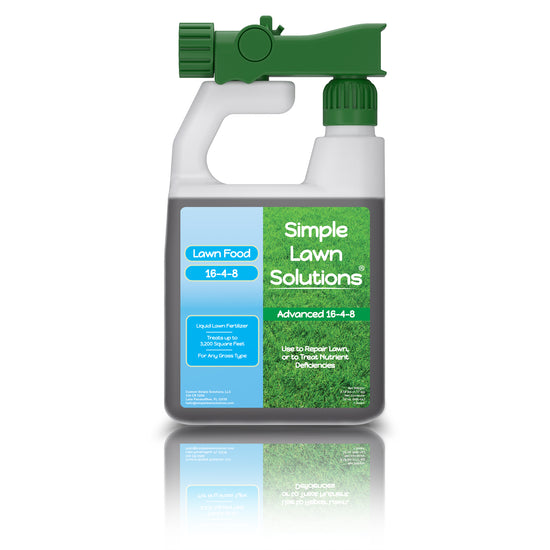
Applying lawn fertilizers in the spring has a direct impact on winter recovery and increasing growth. Simple Lawn Solutions 16-4-8 liquid fertilizer is a balanced fertilizer that helps lawns green up, grow shoots, and build root strength during spring's active growth for both cool-season and warm-season grasses. It is ideal for early spring when the turf is emerging from dormancy.
Simple Lawn Solutions Superior 15-0-15 is a good choice if your soil test shows adequate phosphorus or if there are phosphorus restrictions in the region where your lawn is located. The high percentage of potassium supports turf hardiness and helps the turf remain strong for fluctuating spring conditions.

The Phosphorus Free Lawn Care Bundle for spring maintenance includes nutrition tailored for lawns where phosphorus isn’t needed or is restricted. All of these Simple Lawn Solution products can be complemented by incorporating micronutrients like iron, manganese, and magnesium while enhancing color and metabolism during spring growth when plants are actively greening after dormancy. Seaweed contains both humic and fulvic acids, supporting nutrient absorption, and it fits in perfectly with other lawn fertilizer products.
Should there be a deficiency of phosphorus within your soil testing results, there are products such as Simple Lawn Solutions 3-18-18 or 6-18-0 that can meet the needs required for your lawn.
How to Plan Your Next Liquid Fertilizer Application
The type of grass one has in their lawn is the first step in planning a nutritional program for your grass. Your application schedule should follow active growth and the calendar. Cool-season grasses have peak growth in the spring and fall and when soil temperatures are consistently in the 50–65°F range, is when you should fertilize. Warm-season grasses peak in late spring and throughout the summer, and you should fertilize when temperatures are above 65 to 70°F in soil temperature. Liquid fertilizers like those from Simple Lawn Solutions work best when grass is actively growing and able to absorb through the roots and foliage.
All fertilization programs benefit from performing a soil test. Soil testing with an accredited soil lab testing facility will determine what is needed and how often the applications should take place. Low phosphorus soils will benefit from Simple Lawn Solutions 16-4-8 liquid fertilizer, 3-18-18, or 6-18-0 Growth Booster. Soils with adequate levels of phosphorus will be safer and beneficial with 15-0-15. Simple Lawn Solutions Microbooster product supplies your lawn with micronutrients of Iron, Manganese, and Zinc, along with the secondary macronutrients Magnesium and Sulfur. Any nutrient that you may need in your lawn’s soil, Simple Lawn Solutions has the correct product. Liquid fertilizers are designed to be applied every 4 - 6 weeks during the growing season of cool-season and warm-season grasses. Spring is coming soon, so start planning now with soil testing, applying the correct fertilizer, and watching your lawn grow.
References:
-
MU Extention
-
University of Minnesota Extension - Fertilizing Lawns
-
Penn State Extension - Turfgrass Fertilizer: A Basic Guide
-
Michigan State University Extension - Fertilizing Home Lawns to Protect Water Quality
-
University of Florida IFAS - Soil Testing for the Home Lawn
-
Perdue Extension - Understanding Fertilizer Labels
-
Penn State Extension - Turfgrass Nutrient Management
-
Kansas State University - When to Fertilize Turfgrass
-
Clemson Extension - When Should You Fertilize Your Lawn
-
University of Florida IFAS - Florida Urban Turf Fertilizer Rule
-
University of Connecticut Extension - Your Lawn and the Phosphorus Law